
2026 Top MERV 17 HEPA Filters for Global Buyers
A Merv 17 Hepa Filter can sound like a clear upgrade, but the label deserves a closer look. MERV and HEPA describe different filtration classifications, and buyers should not assume that “MERV 17” automatically proves HEPA performance. In 2026, global purchasers need evidence they can compare: test methods, particle-size efficiency, airflow resistance, dimensions, and the conditions behind each claim. The fine print matters. A filter that captures more particles may also increase pressure drop, affecting fan performance and energy use.
Dr. William Bahnfleth, an indoor-air-quality researcher and former ASHRAE president, has emphasized a practical principle: filtration should be evaluated as part of the building’s complete HVAC and air-quality strategy. This is a paraphrase, not a direct quotation. That perspective shapes this guide’s comparison of suppliers, test documentation, construction quality, and application fit. It also prompts a useful question: will the filter perform well in the actual system, not only in a product listing? A buyer should check replacement availability, frame fit, and operating limits before ordering. Small details count. A poorly matched filter can create trouble at the edge of a busy production line or inside a compact air handler. The market’s terminology is not always consistent, either. This guide flags that uncertainty rather than treating every “MERV 17 HEPA” claim as equivalent. The goal is practical: help global buyers compare products carefully and request verifiable evidence before making a purchase.
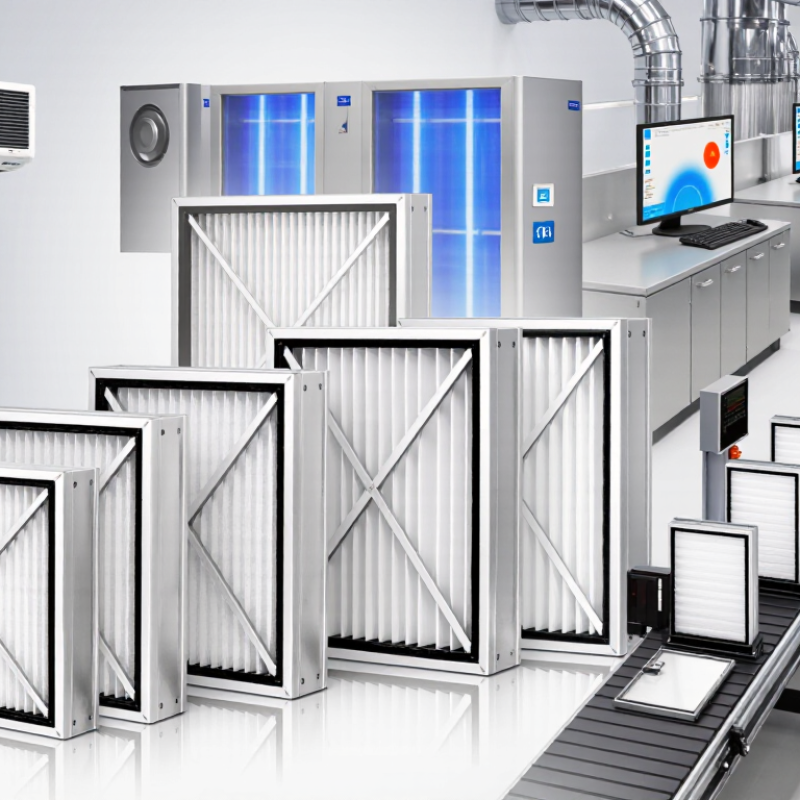
What MERV 17 and HEPA Ratings Mean in 2026
2026 Top MERV 17 HEPA Filters for Global Buyers
What MERV 17 and HEPA Ratings Mean in 2026
MERV and HEPA describe different performance frameworks. ASHRAE Standard 52.2 assigns MERV ratings from 1 through 16, so “MERV 17” is not a standard rating under that scale. Ask sellers for the actual test method and report, not just the label. That distinction matters.
HEPA performance is commonly described as capturing at least 99.97% of particles at 0.3 microns under the U.S. Department of Energy definition. This figure does not mean every filter performs identically across all particle sizes or operating conditions. European EN 1822 and ISO 29463 classifications use the most penetrating particle size, so check which standard supports a supplier’s claim.
A high-efficiency filter also needs to fit the air system. Its resistance can reduce airflow if the fan or housing is unsuitable; a strong rating alone cannot guarantee clean air in a room. Check the test. Request pressure-drop data at the stated airflow, plus dimensions and leakage-test details. I would be cautious with vague “HEPA-grade” wording: it sounds precise, but may leave the actual test unclear. Sources: ASHRAE Standard 52.2; U.S. Department of Energy, HEPA filter definition; EN 1822.
2026 Top MERV 17 HEPA Filters for Global Buyers - What MERV 17 and HEPA Ratings Mean in 2026
Important: MERV 17 is not a rating category in the ASHRAE Standard 52.2 MERV scale, which runs from MERV 1 to MERV 16. A product described as “MERV 17” should be checked against its actual test standard and certified performance; the label alone does not establish that it is HEPA.
| Rating or filter class | Standard and test basis | What the rating indicates | Buyer checks |
|---|---|---|---|
| MERV 13 | ASHRAE Standard 52.2 | Minimum reported efficiency: 50% for 0.3–1.0 µm, 85% for 1.0–3.0 µm, and 90% for 3.0–10.0 µm particle-size ranges. | Confirm the HVAC system can accommodate the filter’s resistance and dimensions. |
| MERV 14 | ASHRAE Standard 52.2 | Minimum reported efficiency: 75% for 0.3–1.0 µm, 90% for 1.0–3.0 µm, and 95% for 3.0–10.0 µm particle-size ranges. | Ask for the test report and pressure-drop data at the intended airflow. |
| MERV 15 | ASHRAE Standard 52.2 | Minimum reported efficiency: 85% for 0.3–1.0 µm, 90% for 1.0–3.0 µm, and 95% for 3.0–10.0 µm particle-size ranges. | Check that the installation prevents air from bypassing the filter. |
| MERV 16 | ASHRAE Standard 52.2 | Minimum reported efficiency: 95% in each of the 0.3–1.0, 1.0–3.0, and 3.0–10.0 µm particle-size ranges. | Verify fan capacity, filter-slot compatibility, and the system’s allowed pressure drop. |
| “MERV 17” claim | Not an official MERV category under ASHRAE Standard 52.2. | The number alone does not define a recognized efficiency class or prove HEPA performance. | Request the named standard, independent test documentation, test conditions, and particle-size efficiency results. |
| HEPA, U.S. convention | A commonly cited U.S. HEPA definition is at least 99.97% efficiency at 0.3 µm. | A HEPA claim is not interchangeable with a MERV rating; confirm the applicable test method and certified filter configuration. | Check whether the full assembly, including frame and seals, is tested for the intended application. |
| EN 1822 H13 | European classification; efficiency is assessed at the most penetrating particle size (MPPS). | H13 requires at least 99.95% overall efficiency at MPPS; the standard also specifies a local-efficiency limit. | Request the EN 1822 classification and test certificate for the offered filter. |
| EN 1822 H14 | European classification; efficiency is assessed at the most penetrating particle size (MPPS). | H14 requires at least 99.995% overall efficiency at MPPS; the standard also specifies a local-efficiency limit. | Confirm housing integrity, sealing, airflow, and the exact test documentation. |
| Global procurement checklist | Compare like with like: identify the test standard and particle-size basis; verify dimensions, airflow, initial and final pressure drop, temperature and humidity limits, sealing requirements, and replacement availability. MERV, U.S. HEPA conventions, and EN 1822 classes use different classification and testing approaches and should not be treated as direct equivalents. | ||
Note: Efficiency figures are rating thresholds, not a guarantee of identical performance in every installation. Actual system performance also depends on airflow, fit, bypass leakage, and maintenance.
FAQS
The 52.2 scale runs from MERV 1 to MERV 16. Ask what test supports a “MERV 17” claim.
A commonly cited definition is at least 99.97% capture at 0.3 micrometers. Results can vary across particle sizes and operating conditions.
No. They use different performance frameworks and test methods. Check the specific standard behind each claim.
Particles can strike fibers, collide with them, or move irregularly until they make contact. It is not simple sieving.
No. A filter may restrict airflow, and gaps can let untreated air pass around the media. Fit matters too.
Ask for the test report, particle-size range, airflow, and pressure-drop data. Check the report date as well.
Confirm the frame’s width, height, and depth. Inspect the gasket and edges; even small gaps can reduce performance.
Request dimensional drawings, leakage-test details, operating limits, and protective packaging information. I still find “high efficiency” too vague on its own.
Conclusion
In 2026, buyers comparing high-efficiency air filtration should understand that MERV ratings and HEPA classifications describe performance using different test methods and criteria. A Merv 17 Hepa Filter is intended to capture very small airborne particles, but its effectiveness depends on the verified test results, filter design, and installation. Comparing options requires more than a headline rating: review particle-size efficiency, airflow resistance, dimensions, service life, and operating conditions to determine whether a filter suits a particular system.
These filters may be used in settings such as healthcare, laboratories, clean manufacturing, and other environments where careful particle control is important. Global buyers should assess suppliers by requesting clear, current test documentation, checking manufacturing quality and traceability, and confirming that product claims and compliance documents meet the requirements relevant to their market. Matching verified performance to the application helps support reliable filtration without compromising system airflow.
