Featured Industrial Filtration Hardware & Systems
Precision-engineered HVAC air filters, deep-pleated HEPA modules, and specialized industrial air treatment units tailored for global industrial requirements.








Global Industrial Air Filtration Market: Paradigms, Net-Zero ESG Goals & Regulatory Pressures
The global industrial air filtration sector is experiencing a structural pivot. Driven by stringent environmental, social, and governance (ESG) mandates, tightening ambient particulate standards (such as EN ISO 16890, EN 1822:2019, and ASHRAE 52.2-2017), and accelerated microelectronics manufacturing, clean air is no longer merely an operational utility—it is a critical core asset.
Modern industrial facilities—spanning sub-micron semiconductor cleanrooms, sterile biopharmaceutical fill-finish suites, heavy-duty gas turbine intake platforms, and commercial HVAC super-structures—face a dual challenge: maintaining absolute contamination control while radically slashing life-cycle operational energy consumption.
In thermal dynamic HVAC environments, up to 70% of an air filter's total life cycle cost (LCC) is directly attributable to electrical fan energy consumption needed to overcome initial and terminal differential pressure (ΔP). Selecting high-efficiency, low-drag media constructs like electrostatically enhanced meltblown synthetic media or expanded PTFE (ePTFE) membranes represents the single most impactful lever for industrial plant managers to reduce operating overhead while upholding uncompromised ISO Class 1 to ISO Class 8 cleanliness standards.
Key Takeaways for Procurement Officers
- Energy Optimization: Low-pressure drop V-Bank and mini-pleat designs yield up to 34% reduction in annual fan kilowatt-hours.
- Structural Reliability: Gel-seal liquid-tank designs eliminate bypass leakage risks in critical ISO 5 pharmaceutical ceiling grids.
- Thermal Compliance: High-temperature HEPA modules with aluminum separators withstand continuous operations up to 350°C (662°F).
- Molecular Control: Laminated activated carbon mesh targets VOCs, acid gases, and airborne molecular contamination (AMC).
Industrial Air Filter Classification & Standardized Performance Matrix
From coarse pre-filtration to Most Penetrating Particle Size (MPPS) ULPA filtration, examine the complete performance spectrum engineered by Snow Peak Clean Technology.
| Filter Class / Category | Standard Classification | Efficiency Benchmark | Primary Media & Frame Construction | Typical Industrial Target Application |
|---|---|---|---|---|
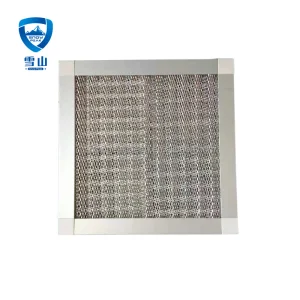
| Coarse Pre-Filters | G3, G4 / MERV 8 | Gravimetric Arrestance > 90% (ePM10 ≥ 50%) | Thermobonded Synthetic / Washable Metallic Mesh / Cardboard or Galvanized Steel Frame | AHU Air Intake Pre-filtration, Paint Booth Floor Filters, HVAC Coil Protection |
| Medium & Fine HVAC | M5, M6, F7, F8, F9 / MERV 11–16 | ePM1 50% – 85% (ISO 16890) | Meltblown Synthetic Pocket Bags / Pleated V-Bank Compact Plastic Enclosures | Commercial Ventilation, Data Center Cooling, Food & Beverage Processing Line |
| High Temperature HEPA | H13, H14 (EN 1822) | ≥ 99.97% – 99.995% at 0.3μm | Micro-glass Fiber Paper + Corrugated Aluminum Foil Separators + Stainless Steel Frame | Sterilization Tunnels, Pharmaceutical Depyrogenation Ovens, High-Temp Exhaust |
| Cleanroom Gel-Seal HEPA | H14, U15 (EN 1822) | ≥ 99.995% – 99.9995% at MPPS | Ultra-fine Micro-glass / Mini-pleated Fold / Polyurethane Gel Channel + Extruded Anodized Aluminum | Semiconductor Photolithography, Biotech Laminar Flow Hoods, ISO Class 3 Cleanrooms |
| Molecular / VOC Carbon | ISO 10121 Compliant | Chemical Adsorption / CTC Rate 60%-90% | Granular / Pelletized / Carbon-Impregnated Non-Woven Fabric with Wire Mesh Support | Odour Control, Semiconductor AMC Removal, Chemical Plant Exhaust Scrubbing |
Multi-V (W-Shape) Compact Architecture
Designed for ultra-high volumetric airflow rates up to 4000 m³/h per unit, V-Bank (2V to 6V) filters pack up to 30 m² of media surface into a standard 610x610mm frame, dramatically reducing face velocity and initial resistance.
Gel Seal Liquid Tank Integrity
Features a continuous channel filled with non-flowing, self-healing polyurethane or silicone gel. When inserted over standard knife-edge ceiling grids, it provides absolute zero-leakage sealing mandatory for pharmaceutical cGMP compliance.
High-Temp Structural Separators
Utilizing precision-corrugated aluminum foil separators alongside heat-cured silicone sealant and 304/316 stainless steel frames, these units withstand extreme thermal expansion cycles up to 350°C without media degradation.
Proven Technical Expertise backed by Rigorous Quality Engineering
Shenzhen Snow Peak Clean Technology Co., Ltd. operates state-of-the-art cleanroom manufacturing suites, deploying automated pleating lines and individual particle scanning equipment adhering to EN 1822 & ISO 29463 guidelines.
Field-Tested Solutions Across Critical Industrial Sectors
Discover how customized industrial air filter configurations solve targeted contamination challenges in high-stakes environment setups worldwide.
Semiconductor Fabs & Microelectronics Cleanrooms
Nanometer-scale photolithography processes require absolute freedom from sub-micron airborne particles and volatile organosilicon contamination. Our liquid tank gel-seal mini-pleat HEPA/ULPA filters deliver guaranteed 99.9995% efficiency at 0.12μm, mounted in automated FFU (Filter Fan Unit) ceiling grids.
Biopharmaceutical cGMP Manufacturing
Aseptic processing and sterile filling lines (Grade A/B) demand leak-proof air boundary integrity. Snow Peak supplies custom mini-pleat HEPA filters with top-side gel seals along with Bag-In-Bag-Out (BIBO) containment housings, ensuring biosecure hazardous particulate isolation.
Automotive Painting & Surface Finishing
To eliminate cratering and surface blemishes on automotive chassis, paint spray booths rely on progressive-density 600G ceiling filter cotton and G4 wire-mesh pleated pre-filters, creating uniform laminar airflow velocity across curing chambers.
Gas Turbine & Power Generation Air Intakes
Coastal and desert power installations contend with heavy salt spray, fog, and sandstorms. High-strength plastic frame V-Bank compact filters with hydrophobic meltblown media protect turbine blades against fouling, erosion, and hot-corrosion.
Technical Roadmap & Next-Generation Filtration Technologies
Snow Peak Clean Technology is pioneering next-decade filtration breakthroughs designed to lower life-cycle carbon footprints and optimize air clarity.
Polymer Nanofiber Spin-Coating
By integrating electrospun nanofibers (fiber diameter < 100nm) onto durable non-woven substrates, our next-gen media achieves mechanical capture of ultra-fine sub-micron particles with a 40% lower pressure drop than traditional micro-glass.
Bio-Based & Recyclable Enclosures
Transitioning from virgin petroleum plastics to fully incinerable bio-polymers and recycled ABS frames, offering industrial enterprises a circular solution for spent filter cartridge management and carbon tax reduction.
IoT-Integrated RFID & Differential Sensors
Embedding passive RFID tags and printed pressure-sensing strips directly into industrial filter header frames enables predictive predictive maintenance alerts within Building Management Systems (BMS).
Frequently Asked Technical Questions (FAQ)
Expert insights addressing specification, compliance, sizing, and replacement protocols for industrial engineers and global buyers.
How do I determine whether to choose Mini-Pleat or Deep-Pleat HEPA filters with separators?
Mini-Pleat HEPA filters feature low profile depths (typically 50mm to 120mm), using thermoplastic hot-melt bead separators. They are ideal for space-constrained installations, cleanroom ceiling grids (FFUs), and applications requiring uniform laminar airflow. Deep-Pleat HEPA filters (typically 150mm to 292mm deep) utilize corrugated aluminum foil separators and micro-glass media. They offer exceptional mechanical strength, larger dust-holding capacities, and superior resistance to turbulent air flows or elevated temperatures up to 350°C.
What is the difference between Gel-Seal (Liquid Tank) and Gasket-Seal HEPA filters?
Gasket-Seal filters rely on compression of a neoprene or continuous-pour polyurethane foam gasket against a flat housing flange. While suitable for standard HVAC cleanrooms, improper torque can cause frame warping and bypass leakage. Gel-Seal filters feature a channel around the frame filled with a fluid polyurethane gel. When pressed over a knife-edge housing rail, the gel forms an airtight, vibration-proof seal without mechanical stress, rendering gel-seal the gold standard for pharmaceutical cGMP (ISO 5 / Class 100) suites.
How does ISO 16890 compare to the legacy EN 779 standard for general ventilation filters?
EN 779 categorized filters (G1-F9) based solely on 0.4μm synthetic dust particle capture efficiency. The global ISO 16890 standard tests performance across a continuous spectrum (0.3μm to 10μm) and classifies filters into four real-world particle size fractions: ePM1, ePM2.5, ePM10, and ISO Coarse. This provides plant engineers with direct correlation to ambient air quality indexes and precise calculations for indoor PM2.5 reduction.
Can Snow Peak manufacture custom sizes, non-standard frame materials, and private labels?
Yes. As a direct OEM/ODM manufacturer with 15+ years of production heritage, we support full custom engineering. We produce non-standard dimensional filters with millimetric precision, utilizing frame materials such as extruded anodized aluminum, 304/316 stainless steel, galvanized iron, heavy-duty cardboard, or high-impact ABS plastic. Custom laser branding, private label packaging, and individual factory test reports are available upon request.
What quality assurance protocols are applied to HEPA and ULPA filter shipments?
Every single HEPA and ULPA filter produced in our cleanroom facility undergoes rigorous quality control. This includes raw material IQC inspection, followed by 100% individual leak testing and pressure drop validation using automated particle counters in accordance with EN 1822-4/5 and ISO 29463 standards. Each unit is shipped with an individual certificate of test performance outlining its specific MPPS efficiency and initial differential pressure.
What is the recommended replacement frequency and terminal pressure drop (ΔP) for industrial air filters?
Primary pre-filters (G3/G4) are typically replaced when initial resistance doubles or reaches 250 Pa (approx. 2-3 months). Secondary bag or V-Bank filters (F7-F9) are serviced at 450 Pa (approx. 6-12 months). HEPA final filters (H13/H14) should be replaced when terminal resistance reaches 600 Pa or when scan testing reveals unrepairable pinhole bypass leaks during scheduled qualification audits.
Industrial Pre-Filtration, Washable Mesh & Specialty Media Series
Explore primary air intakes, metal mesh scrubbers, BIBO replacement bags, synthetic rolls, and paint room filtration media available for global distribution.