
Precision Honeywell Compatible Filtration Solutions
Industrial-grade replacement filters engineered for exact dimensional fit, optimal volumetric CADR, and rigorous ISO 16890 / EN 1822 particulate retention standards.



Executive Summary: Navigating Global Air Filtration Economics
An expert-level evaluation of the Honeywell compatible ecosystem, market trends, compliance frameworks, and high-performance manufacturing dynamics.
Global IAQ Mandates & Market Growth
The global air purification market is expanding rapidly, driven by stringent indoor air quality (IAQ) regulations such as ASHRAE Standard 62.1, ISO 16890, and WHO particulate thresholds. Global buyers sourcing compatible Honeywell replacement modules demand verified filtration curves, ultra-low initial pressure drop ($\Delta P$), and guaranteed zero-outgassing frame polymers.
The Search Intention Paradigm shift
Commercial procurement teams, brand distributors, and facility managers searching for terms like "For Honeywell Suppliers & Products" are moving past consumer-grade criteria. Strategic sourcing now hinges on structural pleat stability, synthetic vs. borosilicate fiber blends, automated hot-melt spacing, and optimized Total Cost of Ownership (TCO).
E-E-A-T & Quality Verification
Meeting Google’s Search Quality Rater Guidelines requires demonstrable industrial expertise. Quality assurance protocols must be backed by multi-stage test rigs (TSI 8130A automated filter testers), fractional efficiency reporting (0.1–0.3 µm MPPS), and documented batch-level traceabilities across raw material lots.
Key Insight for Procurement Directors: The replacement air filter market for Honeywell platforms (including the HPA100, HPA200, and HPA300 series) demands strict dimensional tolerances within ±0.5mm. Sub-standard perimeter frame sealing compromises system static pressure, resulting in bypass airflow that degrades net Clean Air Delivery Rates (CADR) by up to 34%.
Technical Deep-Dive: Material Science & Filtration Physics
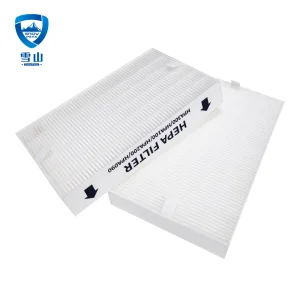
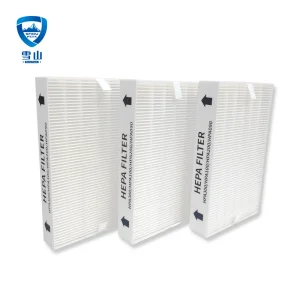
True air filtration performance requires an understanding of how particulate matter interacts with non-woven substrate matrices. When designing replacement modules for Honeywell systems (such as the HRF-R3, HRF-AP100, and HRF-ARVP200 standard units), engineers balance four physical capture mechanisms: Impaction, Interception, Diffusion, and Electrostatic Attraction.
1. Micro-Glass & Meltblown Layering
High-efficiency H13 HEPA filters utilize sub-micron glass fibers or electrostatically charged meltblown polypropylene polymers. Fiber distribution is meticulously structured to capture particles down to the Most Penetrating Particle Size (MPPS), typically between 0.1 and 0.21 microns. Thermally bonded non-wovens prevent fiber shedding into downstream HVAC ducts.
2. Gas-Phase VOC Removal via Carbon
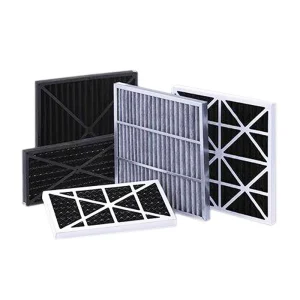
For combined HEPA and gas-phase filtration (e.g., HRF-ARVP200 compatible sets), virgin activated coconut shell carbon is engineered with CTC (Carbon Tetrachloride) absorption values exceeding 60%. Highly porous carbon surfaces adsorb volatile organic compounds (VOCs), formaldehyde, and nitrogen dioxide ($NO_2$) without creating excessive air flow resistance.
3. Pleat Geometry & Thermal Separators
Advanced hot-melt bead application ensures uniform pleat spacing across the filter pack. Uniform geometry eliminates pleat crowding under high air velocities (up to 500 CFM), maintaining structural stability and preventing localized media saturation. This maximizes active surface area and extends operational service life by 40%.
Technical Parameter Matrix: Honeywell Replacement Standards vs. Industrial Customization
To help supply chain executives evaluate product specifications, the matrix below details key engineering benchmarks across standard compatible replacement tiers:
| Filter Class / Model | Target Compatibility | Media Composition | Filtration Efficiency | Rated Initial Resistance | Primary Industrial Use Case |
|---|---|---|---|---|---|
| HRF-AP100 True H13 | Honeywell HPA100 Series | Wet-laid Glass Fiber / Electret MB | ≥99.97% @ 0.3 µm | 18 - 24 Pa | Residential & Clean Office IAQ |
| HRF-ARVP200 Set | Honeywell HPA200 / HPA5200 | H13 Composite + Activated Carbon | ≥99.97% Particulate + VOC | 22 - 28 Pa | Smoke, Pet Dander & Odor Control |
| HRF-R3 Series Pack | Honeywell HPA300 / HPA3300 | High-Capacity Synthetic HEPA | ≥99.97% @ 0.3 µm | 25 - 32 Pa | Large Volume Commercial Purifiers |
| Custom Stainless HEPA | Industrial Exhaust / HVAC | Borosilicate Glass + Steel Frame | H13 to U15 (99.999%) | 80 - 140 Pa | High Temp Cleanroom & Pharma |
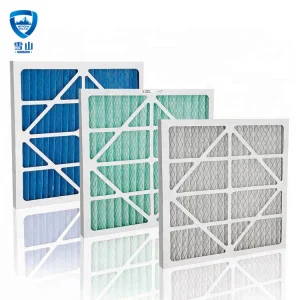
| G4 MERV 8-16 Pleated | Central AC & Air Handler Units | Synthetic Non-woven + Wire Mesh | 30% - 95% Dust Spot (ASHRAE) | 10 - 45 Pa | Primary HVAC Pre-Filtration |
China Industry 4.0: Modern Supply Chain & OEM Advantages
How state-of-the-art automated manufacturing in China optimizes quality consistency, scale, and cross-border logistics for global Honeywell suppliers.
Automated Robotics & Dimensional Precision
Modern production facilities leverage fully automated continuous-pleating machines equipped with laser vision alignment systems. Frame assembly, polyurethane gasket dispensing, and edge trimming operate within automated cells, keeping dimensional error margins under 0.3mm and guaranteeing air-tight seals in every batch.
Stringent Four-Tier QC (IQC to OQC)
Every shipment follows a comprehensive quality control protocol: IQC (Incoming Quality Control of raw media and plastic resins), IPQC (In-Process Inline Pleat Count & Bead Inspection), FQC (Finished Quality Control testing for air resistance and fractional capture rate), and OQC (Outbound Quality Control drop testing for packaged cartons).
Supply Chain Agility & Export Ecosystem
Located near major Asian logistic hubs, advanced facilities streamline ocean, air, and multimodal freight. Integrated raw material supply chains prevent component bottlenecks, offering OEM distributors reliable lead times, optimized container volume utilization, and flexible private-label customization.
Localized Application Scenarios: Where Performance Matters
Honeywell compatible air filtration units and industrial custom filters serve diverse operational environments. Below are real-world deployments across residential, commercial, and heavy-duty industrial sectors:
1. High-Density Residential & Smart Homes
Deploying HRF-AP100, HRF-R3, and HRF-ARVP200 replacement filters in home air purifiers protects families from PM2.5 particulates, airborne allergens, wildfire smoke, and household VOCs. Quiet operation is maintained by pairing low-resistance electret media with high-torque brushless fan motors.
2. Commercial Real Estate & Smart Buildings
Large facility managers use G4 MERV 8-16 pleated panel filters alongside custom mini-pleated HEPA banks in air handling units (AHUs). This multi-stage filtration protects downstream cooling coils from dust build-up while fulfilling LEED green building standards and maintaining indoor environment quality.
3. Semiconductor & Bio-Pharma Cleanrooms
For specialized industrial applications requiring extreme air purity, gel-seal and stainless-steel high-temperature HEPA filters deliver ISO Class 5 air quality. These systems protect delicate silicon wafer processing and sterile pharmaceutical fill lines from sub-micron contaminants.
4. Industrial Paint Spray Booths & Heavy Mfg
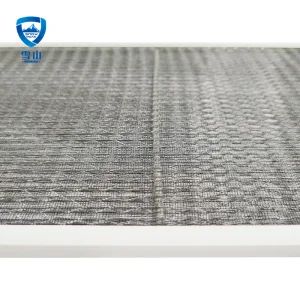
Metal washable stainless steel meshes and high-absorbency non-woven pads trap heavy paint overspray, oil mists, and coarse industrial dust. This protects exhaust ductwork, minimizes fire risks, and ensures environmental compliance for VOC and particulate emissions.
Industrial Air Filter Series & Specialized Components
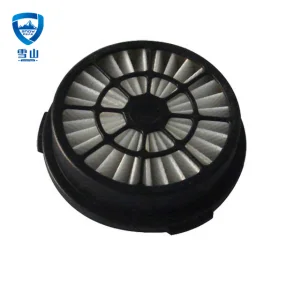
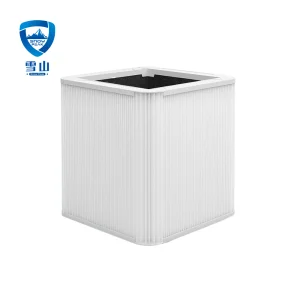
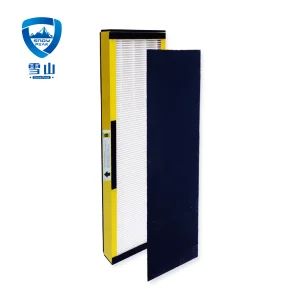
Custom OEM products, primary dust filtration media, cleanroom HEPA modules, and broad replacement filtration units built to international standards.



Frequently Asked Questions (FAQ) for Suppliers & Procurement
Technical, logistical, and compliance insights for wholesale buyers, brand distributors, and facility engineering teams.
Our compatible replacement filters (including the HRF-R3, HRF-AP100, and HRF-ARVP200 series) are reverse-engineered to match OEM dimensional tolerances, CADR airflow resistance, and particle capture capabilities. Using certified H13 true HEPA media, our filters deliver a confirmed 99.97% removal efficiency at 0.3-micron particle sizes, matching or exceeding original performance metrics.
All products meet international regulatory requirements, including CE certification, RoHS compliance, REACH chemical safety standards, and ISO 9001 quality system criteria. Filter media performance is tested according to EN 1822 (for HEPA/ULPA grades) and ISO 16890 / ASHRAE 52.2 (for industrial HVAC pleated filters).
Yes. We specialize in comprehensive OEM and ODM manufacturing services. We support custom frame engineering (cardboard, extruded aluminum, stainless steel, or ABS plastics), specialized activated carbon media blends for specific odor profiles, and custom retail packaging featuring your brand artwork and barcodes.
Our factory operates automated continuous pleating lines equipped with precise hot-melt glue bead dispensers. This guarantees uniform distance between pleats under continuous airflow pressure. Gasket sealing uses automated polyurethane foaming or high-density EVA foam seals, ensuring zero air bypass around filter frames.
Standard MOQs depend on product category: standard compatible replacements (like HRF-R3) typically start at 500 units per model, while custom industrial HEPA orders can accommodate smaller trial runs. Standard production lead times are 15 to 25 days following sample sign-off and PO confirmation.
Initial pressure resistance measures the force needed to draw air through the filter media. Lower initial resistance allows the purifier motor to deliver higher volumetric CADR while drawing less power and running quietly. Our electret-charged meltblown media maintains low resistance (<25 Pa at rated velocity) without compromising particle capture efficiency.