


1. Engineering Fundamentals of Non-Pleated Air Filtration Architecture
In modern industrial ventilation, contamination control, and environmental engineering, air filtration mechanisms are divided broadly into surface filtration and depth filtration. While pleated filters leverage expanded surface area through micro-geometry folds, non-pleated air filters utilize dynamic progressive-density fiber structures, deep pocket geometries, porous reticulated matrices, and non-woven lofted media to achieve exceptional dust holding capacity (DHC) and ultra-low initial pressure drops.
As a globally recognized CE Certification Non Pleated Air Filters Manufacturer & Exporter, our engineering facilities focus heavily on optimization of fluid mechanics within non-pleated configurations. Non-pleated systems eliminate high-velocity turbulence pockets frequently caused by tight pleat pitch spacing, thereby delivering uniform face velocity distribution across the entire filter matrix.
Depth Filtration vs. Surface Filtration Mechanisms
The fundamental mechanical advantage of non-pleated media—such as pocket/bag filters, synthetic media rolls, needle-punched non-wovens, and reticulated foam pads—lies in multi-stage tortuosity. Particulate matter does not collect exclusively on a single front boundary layer; instead, larger particles (5–10 µm) are trapped in the coarse outer matrix via inertial impaction, while finer sub-micron particles (0.3–1 µm) penetrate deeper to be captured through Brownian diffusion and interception.
Inertial Impaction
Heavy particulate contaminants deviate from air streamlines due to inertia, embedding permanently into outer coarse fiber layers without blinding the filter.
Interception & Diffusion
Fine aerosolized particles follow tortuous micro-paths within thermal-bonded synthetic fiber layers, ensuring high removal efficiency across EN779 and ISO 16890 test spectrums.
Gradient Density Structure
Engineered from coarse open-pored upstream fibers to fine downstream microfiber matrices, preventing premature face loading and maximizing structural lifecycle.
2. CE Certification, ISO Compliance & European Quality Assurance
Exporting air filtration hardware to the European Economic Area (EEA) and global municipal enterprise projects demands rigorous verification of physical safety, material toxicity, fire retardancy, and aerodynamic efficiency. Our non-pleated air filter series holds comprehensive CE Certification, validating strict alignment with relevant EU Directives, including industrial safety standards, pressure equipment norms, and REACH/RoHS toxicological compliance.
Our non-pleated products are tested under strict lab environments adhering to ISO 16890 (Coarse, ePM10, ePM2.5, ePM1), EN 779:2012 (G2-G4, M5-M6, F7-F9), and high-efficiency HEPA standard EN 1822:2019. Furthermore, frame components meet DIN 53438 / EN 13501-1 Class F1 / K1 self-extinguishing flame retardancy mandates.
| Filter Class (EN779) | ISO 16890 Rating | Target Particle Size | Primary Industrial Application | Media Construction Type |
|---|---|---|---|---|
| G2 – G4 | ISO Coarse 40% – 85% | > 10 µm (Pollen, Coarse Dust) | HVAC Pre-filtration, Paint Booths | Thermobonded Synthetic / Glass Fiber |
| M5 – M6 | ePM10 50% – 70% | 3 – 10 µm (Cement Dust, Mold) | Commercial AHU, Industrial Ventilation | Pocket Bag Meltblown Synthetics |
| F7 – F9 | ePM1 55% – 85% | 0.3 – 1 µm (Fine Smog, Bacteria) | Cleanroom Pre-stage, Food & Pharma | Multi-Layer Micro-Synthetic Non-woven |
| E10 – H14 | ISO 29463 / EN 1822 | 0.1 – 0.3 µm (Aerosols, Viruses) | Medical Facilities, Semiconductor Labs | Mini-Pleat / Deep Non-pleated Composite |
3. Macro-Industry Solutions & System Integration Strategies
As enterprise procurement requirements evolve toward dynamic total cost of ownership (TCO) optimization, non-pleated filter configurations provide custom-tailored answers for demanding commercial, heavy industrial, and municipal air purification challenges.
Commercial HVAC & Building AHUs
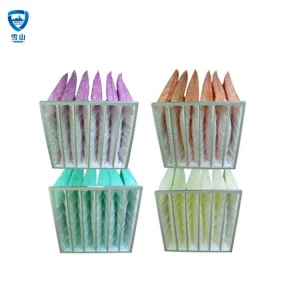
Integrating non-pleated synthetic pocket filters into air handling units (AHUs) reduces blower power consumption by up to 22%. Extended pocket depth allows maximum dust loading with minimal pressure buildup.
Gas Turbine & Power Plant Intake
Heavy-duty continuous operations in coastal or desert environments require non-pleated depth media to handle extreme moisture, salt fog, and high particulate bursts without moisture collapse.
Automotive Spray Booths & Industrial Finishing
Reticulated non-pleated floor filter rolls (paint stop glass-fiber pads) capture overspray aerosols effectively, protecting exhaust ducts while maintaining stable laminar air flow across work zones.
4. China Factory 4.0: Automated Manufacturing & Supply Chain Resilience
High-volume international delivery requires more than manual assembly lines. Our state-of-the-art manufacturing center in China incorporates Industry 4.0 Automation, running fully automated needle-punching, ultrasonic pocket welding, robotic frame gasketing, and computerized continuous meltblown extrusion lines.
Precision Ultrasonic Welding
Eliminates stitch needle holes in pocket bag filters, preventing bypass leakage and ensuring complete pocket inflation under high volumetric airflow.
Strict 4-Stage Quality Control
Every production batch undergoes IQC (Incoming Raw Media Verification), IPQC (In-Process Automated Dimensions Check), FQC (Efficiency & Pressure Drop Testing), and OQC (Export Packaging Audit).
Agile B2B Export Logistics
Located near major deep-water ports, we offer optimized container consolidation, vacuum-compressed media packing, and customized private-label OEM export boxing.
5. Global Enterprise Procurement & Total Cost of Ownership (TCO)
For enterprise procurement officers and facility engineering leaders, purchasing decisions extend far beyond initial unit price (CAPEX). Operating energy costs (OPEX) account for over 70% to 80% of the total lifetime cost of an air filter installation. Non-pleated filters excel at minimizing lifecycle operational expenses by extending operational longevity and preserving low differential pressure profiles.
TCO = Purchase Cost (CAPEX) + Energy Cost (OPEX) + Maintenance & Disposal Cost
Energy Cost (kWh) = (Airflow [m³/s] × Average Pressure Drop [Pa] × Operating Hours [h]) / (Fan Efficiency × 1000)
By selecting our CE-certified non-pleated synthetic bag and depth filters, facilities achieve significantly lower average differential pressures across thousands of operational hours. This translates directly to reduced kilowatt-hour demand from primary AHU supply fans, generating substantial annual financial savings and lowering corporate carbon footprints.
6. Non-Pleated Air Filtration Technology Roadmap & Future Outlook
The future of industrial clean air engineering hinges on sustainable media, smart monitoring, and advanced surface-functionalized polymers. Our R&D division is actively driving key innovations slated for deployment across global markets over the next decade:
Electrospun Nanofiber Layers
Applying ultra-thin nanofiber coatings onto non-pleated synthetic backing media boosts sub-micron aerosol capture without increasing physical media density or airflow restriction.
Bio-Based & Recyclable Polymers
Transitioning from virgin petroleum synthetics to bio-derived PLA (polylactic acid) and fully recyclable monomaterial filter frames to fulfill EU Circular Economy mandates.
IoT Integrated Pressure Sensors
Embedding low-cost printed RFID differential pressure sensors directly into non-pleated filter frames to enable predictive maintenance alerts within smart building management platforms.
7. Frequently Asked Questions (Technical & Commercial FAQ)
Below are expert answers to critical questions raised by industrial HVAC engineers, OEM buyers, and international import distributors:
Q1: What structural characteristics define a non-pleated air filter compared to standard pleated units?
Non-pleated air filters rely on lofted gradient media pads, deep multi-pocket bags, or reticulated porous synthetic beds rather than closely folded V-pleat geometries. This design yields superior volumetric dust holding capacity and uniform face velocity, making them exceptionally well-suited for coarse and medium pre-filtration stages in commercial and heavy industrial HVAC systems.
Q2: How does CE Certification impact international import compliance for air filters?
CE Certification confirms that our air filters meet essential health, safety, and environmental protection requirements established under European Directives. It verifies that materials comply with REACH/RoHS toxicity bounds, structural frames meet flame retardancy mandates (e.g., DIN 53438), and published filtration efficiencies accurately correspond to certified ISO 16890 / EN 779 test standards.
Q3: Can non-pleated synthetic filters replace pleated filters in existing AHU frames?
Yes. Non-pleated pocket bag filters, panel media pads, and multi-layer synthetic rolls can be retrofitted directly into standard holding frames. In many pre-filtration applications, replacing shallow pleated filters with non-pleated deep-pocket bags increases filter operating life by 200% to 300% while significantly reducing airflow resistance.
Q4: What frame material options are available for non-pleated air filters?
We manufacture non-pleated filters with diverse framing options tailored to environmental demands, including rigid galvanized steel, corrosion-resistant anodized aluminum, lightweight extruded ABS plastic, halogen-free polypropylene, and eco-friendly moisture-resistant beverage cardboard.
Q5: What OEM and custom sizing capabilities does your factory provide?
As a direct manufacturer and exporter, we offer complete OEM/ODM flexibility. We produce custom header dimensions, varied pocket counts and depths, specialized media blends (e.g., anti-microbial or activated carbon impregnated synthetics), custom private-label branding, and specialized packaging for bulk international distribution.
Q6: How do non-pleated pocket filters maintain pocket inflation without collapsing under variable air volume?
Our pocket filters incorporate internal aerodynamic ribbon spacers and rigid self-supporting ultrasonic welding seams. This engineered internal geometry ensures uniform air channel distribution, preventing pocket-to-pocket contact or media sag during variable airflow operational cycles.