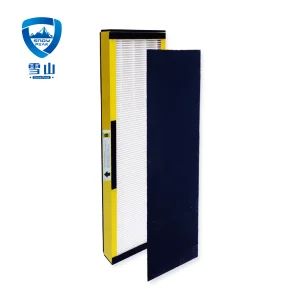
Featured Activated Carbon & HEPA Filtration Products
Explore our top-tier export lines manufactured with precise pore-size distribution, high iodine value media, and robust frame integrity designed for global OEM compatibility.







Global Market Dynamics & The Evolution of Home Molecular Air Filtration
Transitioning from basic dust capture to multi-stage gas-phase adsorption: How advanced activated carbon substrates redefine indoor environmental quality (IEQ).
In modern HVAC architecture and residential air purification design, the challenge of indoor air quality (IAQ) has fundamentally shifted. While mechanical filtration systems—such as H13 and H14 True HEPA filters—excel at trapping solid airborne particulate matter (PM2.5, PM0.1, dust, and biological aerosols), they are completely porous to gas-phase pollutants. Volatile Organic Compounds (VOCs), formaldehyde (HCHO), benzene, nitrogen dioxide (NO2), wildfire smoke, and household odors exist on a molecular scale (0.0001 to 0.005 microns), easily traversing standard fibrous filter webs.
To overcome this limitation, activated carbon technology serves as the chemical backbone for gas-phase contaminant mitigation. Globally, the demand for high-efficiency China activated carbon air filters home product lines has surged. Driven by urban density, modern off-gassing building materials, stringent indoor air regulations, and heightened health awareness, procurement managers across North America, Europe, and Asia-Pacific are seeking advanced composite carbon solutions that balance high Clean Air Delivery Rates (CADR) for TVOCs with minimal initial static pressure drop (ΔP).
Chemical Architecture of Modern Carbon Filter Products
Evaluating raw material carbonization, chemical impregnation techniques, and physical form factors used in residential and HVAC filtration media.
Coconut Shell Virgin Carbon
Sourced from high-density coconut hulls, thermally activated via high-temperature steam (900°C–1100°C). Offers supreme hardness, low dust generation, high Iodine Numbers (900–1200 mg/g), and superior microporosity for light VOC removal.
Chemical Impregnation (Chemisorption)
To neutralize low-boiling-point acidic or alkaline gases (such as H2S, NH3, and Formaldehyde), carbon is impregnated with Potassium Hydroxide (KOH), Potassium Permanganate (KMnO4), or Phosphoric Acid to trigger catalytic conversion.
3D Carbon Structure Types
From bonded carbon pellets and carbon-impregnated polyurethane foam to gradient non-woven carbon fabrics and carbon-filled honeycomb cells, physical structure dictates air resistance and holding capacity.
Technical Specification Comparison: Carbon Filter Media Formats
Understanding the engineering trade-offs between pressure drop, airflow velocity, and single-pass removal efficiency is critical for HVAC OEMs and home air purifier brand managers:
| Media Format | Dust Emission Level | Air Resistance (ΔP @ 1.5 m/s) | TVOC Single-Pass Efficiency | Target Application |
|---|---|---|---|---|
| Pelletized / Granular Carbon (Mesh 4x8, 8x30) | Moderate to High | High (60 - 120 Pa) | 90% - 98% | Heavy-duty commercial, industrial gas scrubbers, luxury purifiers. |
| Carbon Impregnated Reticulated Foam | Very Low | Low (15 - 30 Pa) | 45% - 65% | Residential pre-filters, HVAC return air, kitchen range hoods. |
| Laminated Carbon Non-Woven Composite | Negligible | Medium (30 - 50 Pa) | 70% - 85% | Dual-action HEPA + Carbon combo filters for home air purifiers. |
| Honeycomb Carbon Matrix (ABS / Paper) | Zero | Ultra-Low (10 - 25 Pa) | 80% - 92% | High-CADR room purifiers, automotive cabin air systems. |
China Factory Efficiency & Manufacturing Superiority
Why Chinese filtration hubs (Shenzhen, Dongguan, Jiangsu) maintain an unbeatable edge in cost structure, automated assembly, and strict ISO/EN quality standards.
Vertical Material Integration
China commands over 60% of the world's activated carbon processing capacity and non-woven fabric production. Direct access to raw carbonization plants and thermal bonding facilities eliminates middleman markup and slashes lead times.
Automated High-Speed Pleating
State-of-the-art multi-axis CNC pleating lines ensure uniform pleat spacing, precise hot-melt glue bead dispensing, and structural stability under high volumetric airflow, preventing pleat collapse during operation.
Rigorous QC Testing Framework
Leading Chinese manufacturers operate in-house testing laboratories equipped with TSI 8130A automated filter testers, gas chromatographs, and EN1822 / ISO 16890 particulate counters to guarantee zero bypass and compliance.
End-to-End Quality Control Matrix (IQC to OQC)
A reliable OEM partnership in China is built upon transparent, multi-stage quality assurance protocols. Standard batch testing includes:
- Incoming Quality Control (IQC): Testing raw carbon batch Iodine Numbers (ASTM D4607), moisture content, and particle size distribution. Testing meltblown media for basis weight (g/m²) and pressure drop variance.
- In-Process Quality Control (IPQC): Automated vision systems inspect frame gluing integrity, foam gasket elasticity, and dimension tolerances (±0.5 mm precision).
- Final Quality Control (FQC): Measuring TVOC removal efficiency using challenge gases (Toluene/Formaldehyde) inside controlled environmental test chambers (GB/T 18801 / AHAM AC-1 standards).
- Outgoing Quality Control (OQC): Drop-testing drop-proof retail cartons, anti-humidity vacuum polybag sealing, and pallet stack compression verification before seaport dispatch.
Versatile Deployment Scenarios for Home & Commercial Environments
From smart home desktop purifiers to centralized commercial HVAC fresh-air systems, customized activated carbon products adapt to varied environmental stressors.
Smart Home Air Purifiers
Direct replacement filters engineered for top global consumer brands (Blueair, Honeywell, Coway, Levoit). Combines H13 HEPA with modified carbon to remove pet dander, cooking odors, and renovation formaldehyde.
Residential HVAC & Furnace Air Handler
MERV 13 to MERV 15 pleated panel filters incorporating a carbon-coated synthetic layer. Protects ducted heating and cooling systems from circulating airborne chemicals without strangling blower motor airflow.
Commercial & Institutional AHUs
Pocket bag filters and rigid cell carbon filters utilized in hospital waiting rooms, airports, hotel fresh-air intakes, and commercial office towers to meet ASHRAE 62.1 indoor air standards.
Global Market Trends & Regulatory Compliance
Innovations shaping the future of carbon air filtration: Eco-friendly frames, electrostatic composite enhancement, and strict chemical safety standards.
The global filtration industry is experiencing rapid innovation driven by environmental policy and consumer expectations:
- Transition to Renewable Frames: Replacing unrecyclable high-impact polystyrene (HIPS) and plastic frames with water-resistant cardboard, recycled paperboard, or biodegradable PLA frames to align with EU ESG mandates.
- Hybrid Catalytic Cold-Catalyst Media: Integrating Cold Catalyst and Nano-TiO2 layers alongside activated carbon. Cold catalysts break down formaldehyde into carbon dioxide and water at room temperature without requiring UV activation, vastly extending carbon saturation lifespan.
- Low-DOP Chemical Compliance: Strict adherence to REACH, RoHS, and California Proposition 65 regulations ensures that carbon bonding adhesives emit zero hazardous off-gassing or phthalates into clean air streams.
Global Buyer's Guide: Step-by-Step Sourcing from China Factories
How international purchasing teams can minimize risk, establish custom OEM toolings, and optimize logistics from Chinese manufacturing hubs.
Sourcing custom activated carbon air filters requires structured technical communication to ensure seamless execution. Follow this 4-step procurement framework:
1. Technical RFQ & Spec Sheet
Specify target CADR, dimensional drawing (L x W x H in mm), frame type (Plastic/Cardboard/Aluminum), media type (Honeycomb vs. Granular vs. Foam), target target gases, and MERV/HEPA rating.
2. Prototyping & Chamber Testing
Request 3D-printed prototype frames or rapid-tooling samples. Verify fit in target air purifier units and run 30m³ chamber tests for initial CADR and pressure drop validation.
3. Tooling & Pilot Production
Upon sample sign-off, injection molds or stamping dies are fabricated (typically 15-20 days). A pilot run of 500-1000 units establishes line yield and quality benchmarks.
Engineering & Sourcing FAQ
Detailed answers to complex technical queries commonly raised by HVAC engineers, importers, and private-label brand managers.
Custom OEM Replacement & Industrial Carbon Products
Discover specialized filter elements, mini-pleated HEPA combos, non-woven absorbent pads, and pre-filter media rolls available for export worldwide.