
Featured Air Filtration Products & Replacement Solutions
Engineered for high-volume B2B sourcing, precision fitment, and certified particle arrestance.
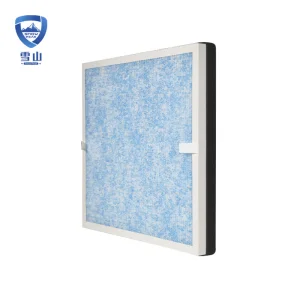






Executive Summary: The Evolution of MERV 16 Fabric Engineering
A comprehensive analysis of sub-micron particulate capture, electrostatic media treatments, and structural fabric design for global OEM and HVAC markets.
ANSI/ASHRAE 52.2 Standard Compliance
MERV 16 (Minimum Efficiency Reporting Value 16) represents the absolute pinnacle of standard HVAC non-HEPA filtration media. Engineered to capture ≥ 95% of airborne particles within the sub-micron size spectrum (0.3 to 1.0 microns), MERV 16 fabrics bridge the gap between traditional commercial air filtration and critical cleanroom HEPA standards. As top-tier China MERV 16 fabric suppliers, our manufacturing methodology focuses on maximizing particle arrestance while eliminating the heavy initial pressure drop traditionally associated with ultra-dense media.
Material Science Transition: Fiber Dynamics
Historically, achieving MERV 16 filtration required thick, high-grammage glass fiber webs that increased fan static pressure and operational power costs. Modern manufacturing leverages composite meltblown nonwovens laminated with spunbond polypropylene (PP) or PET protective scrims. By utilizing bicomponent microfibers subjected to high-voltage corona electret charging, modern MERV 16 fabric relies on both mechanical straining and electrostatic attraction, vastly improving air permeability and energy efficiency.
Global Export Supply Chain Capability
As an established exporter, China’s industrial filtration ecosystem provides unparalleled advantages in roll-goods scalability, custom masterbatch formulation, and strict quality assurance. Overseas buyers gain access to advanced gradient-density fabrics that offer twice the dust-holding capacity (DHC) of single-layer media, minimizing filter replacement frequency in critical cleanroom, healthcare, and commercial infrastructure environments.
Technical Specification Matrix: Fabric Benchmarks
Comparing MERV 16 composite fabric performance against lower MERV ratings and HEPA-grade materials to guide industrial procurement decisions.
| Filter Media Grade | Target Particle Size | Capture Efficiency | Initial Pressure Drop (Pa) | Primary Industrial Applications |
|---|---|---|---|---|
| MERV 8 Synthetic | 3.0 – 10.0 μm | ≥ 70% (E3) | 12 - 18 Pa | Commercial Pre-filtration, Residential AC |
| MERV 11 Meltblown | 1.0 – 3.0 μm | ≥ 65% (E2) | 18 - 25 Pa | Commercial Buildings, General Industrial HVAC |
| MERV 13 Composite | 0.3 – 1.0 μm | 50% – 75% (E1) | 22 - 32 Pa | LEED Green Buildings, Superior IAQ Systems |
| MERV 16 Premium Fabric | 0.3 – 1.0 μm | ≥ 95% (E1) | 28 - 42 Pa | Hospitals, Data Centers, Semiconductor Sub-Fab |
| HEPA H13 (EN1822) | 0.3 μm (MPPS) | ≥ 99.95% | 100 - 140 Pa | Pharmaceutical Cleanrooms, Surgical Suites |
Structural Architecture of High-Gain MERV 16 Fabric
Our engineered MERV 16 roll goods feature a multi-layer progressive structure designed to prevent premature surface loading (caking). The upstream layer consists of a coarse thermal-bonded synthetic fiber web that captures larger nuisance dust (PM10). The core consists of ultra-fine meltblown fibers with a fiber diameter ranging between 1.0 to 3.0 micrometers. This layer is exposed to hydro-electret or corona-charging processing, locking dipole charges into the polymer matrix. The downstream layer is a high-tenacity spunbond nonwoven that provides structural stability during high-speed auto-pleating processes.
Global Enterprise Sourcing Demands & Procurement Economics
Evaluating Total Cost of Ownership (TCO), customized roll dimensions, and international logistics efficiency for supply chain managers.
Total Cost of Ownership (TCO) Optimization
When enterprise buyers source MERV 16 fabric from China, direct material cost is only one component of the equation. Energy consumption accounts for nearly 70% to 80% of an HVAC system’s operational cost over its lifecycle. High-grade MERV 16 fabric with lower initial resistance (e.g., ≤ 30 Pa at 5.3 cm/s face velocity) directly reduces fan power requirements (kWh). This allows facility managers to satisfy stringent indoor air quality (IAQ) mandates without exceeding energy budgets.
OEM/ODM Automated Pleat Compatibility
For filter element manufacturers, fabric convertibility is paramount. Inconsistent thickness, poor stiffness, or variable basis weight can lead to pleat collapse or machine downtime. Our exported MERV 16 roll goods feature high ultrasonic weldability and optimal stiffness coefficients (Gurley stiffness ≥ 800 mg), making them seamlessly compatible with high-speed rotary and blade pleating machines without damaging the delicate electrostatic fibers.
Macro Industry Solutions & Critical Applications
Custom engineering deployments across healthcare, semiconductor manufacturing, and commercial infrastructure.
Healthcare & Pharmaceutical HVAC
Hospital operating rooms, isolation wards, and pharmaceutical packaging lines demand rigorous airborne pathogen suppression. MERV 16 fabrics capture bacteria, droplet nuclei carrying viruses, and fine chemical dust. When installed in multi-stage air handlers, MERV 16 acts as an exceptional pre-stage filter, extending the service life of expensive down-stream terminal HEPA filters by up to 300%.
Semiconductor & Microelectronics Fabrication
In sub-micron semiconductor processing, sub-micron ambient dust can cause fatal micro-bridging errors on silicon wafers. MERV 16 nonwoven fabrics integrated into recirculating air units (RAU) and make-up air units (MAU) safeguard sensitive Lithography and Etch bays from airborne sub-micron particulate intrusion.
Enterprise Data Center Thermal Protection
Modern high-density data centers utilize direct expansion (DX) and chilled water air handlers. Dust accumulation on server heat sinks degrades cooling efficiency and causes thermal throttling. MERV 16 filtration filters out ambient fine particulates, maintaining optimal server airflow and preventing costly thermal shutdowns.
Technical Roadmap & Future Innovations
Next-generation polymer chemistry, nanofiber lamination, and sustainable bio-based filtration media developments.
1. Electrospun Nanofiber Lamination
Traditional meltblown media relies heavily on electrostatic charge, which can slowly decay under high humidity or organic solvent exposure. Our R&D roadmap integrates electrospun PA66 or PVDF nanofibers directly onto the meltblown substrate. Containing micro-pores smaller than 0.5 microns, this nanofiber layer ensures mechanical filtration efficiency that never degrades over time.
2. Hydro-charging vs. Corona Technology
Moving beyond basic corona charging, water-jet hydro-charging technology forces high-pressure pure water streams through the polymer web during extrusion. This embeds a deep, stable dipolar charge throughout the entire thickness of the nonwoven structure, maintaining MERV 16 efficiency ratings even after severe thermal or storage conditioning.
3. Sustainable Eco-Friendly Formulations
With global ESG mandates expanding, we are advancing the commercialization of fully recyclable mono-polymer PP roll goods and biodegradable PLA (Polylactic Acid) microfibers. These eco-friendly fabrics match traditional MERV 16 capture rates while vastly reducing carbon footprints and thermal disposal impact.
Global Regulatory Standards & Testing Integrity
Strict quality assurance protocols verifying physical properties, flame retardancy, and air filtration efficiency.
Rigorous Automated Test Bench Audits
Every exported lot of MERV 16 fabric undergoes strict quality audits using TSI 8130A automated filter testers with NaCl and oil aerosol challenge particles. We continuously track key parameters: fractional efficiency curves, pressure drop at varied face velocities (2.5 to 15 cm/s), basis weight uniformity (g/m² via ISO 9073-1), and tensile strength (N/5cm via ISO 9073-3).
International Compliance Harmonization
Our fabrics comply with both North American and European standard frameworks:
- ANSI/ASHRAE 52.2:2017: MERV 16 Rating Certified.
- ISO 16890:2016: Classified as ePM1 85% & ePM2.5 90%+.
- EN 779:2012: Meets F9 / Fine Filter Class benchmarks.
- UL 900 Flammability: Class 1 / Class 2 fire safety compliance.
- RoHS & REACH: Free from SVHCs, heavy metals, and fluorinated compounds.
Frequently Asked Questions (FAQ) for B2B Sourcing
Direct technical and operational answers to common procurement questions from overseas filter manufacturers and distributors.
Additional OEM Air Filtration Materials & Elements
Explore our complete catalog of precision-engineered cleanroom, industrial HVAC, and specialized filter solutions.





