



Executive Summary & Macro Industrial Air Filtration Architecture
In modern industrial aerodynamics and cleanroom environment design, primary pre-pleated air filters represent the operational cornerstone of indoor air quality (IAQ), HVAC system longevity, and thermodynamic energy efficiency. By capturing coarse airborne particulates (PM10, pollen, lint, and industrial dust) before secondary and tertiary filtration stages, engineered pre-pleat filters mitigate air handler unit (AHU) fouling and significantly reduce lifecycle energy consumption.
Heat Exchanger Coil Protection
Deposition of particulate matter on cooling and heating coils increases thermal resistance and reduces heat transfer coefficients ($\Delta h$). Industrial-grade G3/G4 and MERV 8-13 pre-pleat filters maintain clean coil surfaces, preventing microbial amplification and preserving design SEER performance ratings.
Low Initial Differential Pressure ($\Delta P$)
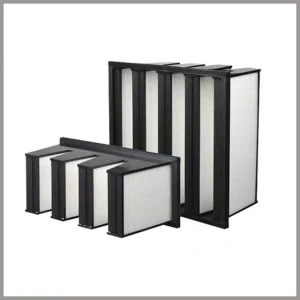
Engineered using V-pleat geometric configurations and gradient-density synthetic fiber matrices, high-performance pre-filters maximize effective filtration surface area. This results in minimal airflow resistance, optimizing fan power curves (kW/CFM) across variable air volume (VAV) systems.
Upstream HEPA Buffer Shields
Critical environments such as microelectronic fabrication facilities, pharmaceutical sterile fill suites, and surgical operating rooms rely on high-cost terminal H13–U17 HEPA/ULPA filters. Pre-pleated elements absorb high particulate loads, quadrupling the replacement intervals of expensive downstream cleanroom filters.
Global Commercial & Industrial Market Landscape
The international air filtration ecosystem is undergoing a major paradigm shift driven by stringent decarbonization mandates (ESG compliance), updated building codes (ASHRAE Standard 62.1), and advanced air purification regulations across North America, Europe, and the Asia-Pacific region.
North America: ASHRAE & MERV Upgrades
Commercial real estate and industrial facility managers across the US and Canada are rapidly transitioning from traditional 1-inch fiberglass throwaways to 2-inch and 4-inch deep pleated MERV 8 to MERV 13 filters. This shift responds to increased awareness of fine ambient PM2.5 particulates and airborne pathogen transmission risks.
Europe: ISO 16890 Standard Transition
European markets have fully embraced ISO 16890 testing standards, evaluating filters based on particulate mass fraction categories: $e\text{PM}_1$, $e\text{PM}_{2.5}$, and $e\text{PM}_{10}$. European facility operators demand pre-filters with verified fractional efficiency ratings, continuous synthetic media, and low energy classification per Eurovent 4/21 guidelines.
Asia-Pacific: High-Density Industrial Hubs
Rapid industrialization, mega semiconductor foundries (fabs), and heavy manufacturing expansion across Southeast Asia and China have surging demand for robust pre-pleat filters. These products must withstand high humidity, aggressive ambient dust loadings, and continuous 24/7 operating cycles.
Material Science, Pleat Geometry & Technical Specifications
China’s leading manufacturing infrastructure leverages precision electrospun synthetic polymers, high-loft needle-punched media, and automated pleating technology to achieve superior Dust Holding Capacity (DHC) while maintaining ultra-low airflow resistance.
| Filter Class / Grade | EN 779 Equivalent | ISO 16890 Classification | Initial Resistance (@ 2.5 m/s) | Primary Substrate Material | Key Industrial Target Applications |
|---|---|---|---|---|---|
| Pre-Pleat G3 | G3 Class | ISO Coarse 50% | 30 – 45 Pa | Thermobonded Synthetic Polyester | Coarse dust, AHU protection, spray booth exhaust |
| Pre-Pleat G4 | G4 Class | ISO Coarse 70% – 85% | 40 – 60 Pa | Gradient-Density Needle-Punched Polypropylene | Commercial HVAC pre-filtration, air compressors |
| High-Cap MERV 8 | M5 Class | $e\text{PM}_{10}$ 50% | 50 – 70 Pa | Electrostatic Continuous Filament Synthetic | Hospitals, data centers, public ventilation |
| High-Cap MERV 11 | M6 Class | $e\text{PM}_{10}$ 70% / $e\text{PM}_{2.5}$ 50% | 65 – 85 Pa | Blended Meltblown / Synthetic Matrix | Pharmaceutical cleanroom pre-stages, commercial office IAQ |
| High-Cap MERV 13 | F7 Class | $e\text{PM}_{2.5}$ 65% / $e\text{PM}_1$ 50% | 80 – 110 Pa | Nanofiber Laminated Substrate | LEED-certified green buildings, isolation wards |
Controlled Pleat Geometry & Hot-Melt Separators
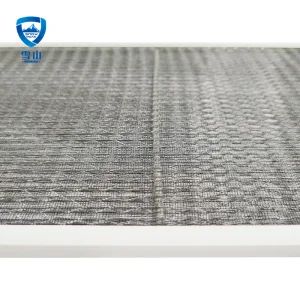
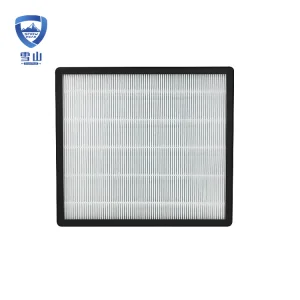
To eliminate pleat deformation (bunching) under heavy airflow loads, automated production lines integrate continuous hot-melt adhesive bead separators or diamond-shaped expanded metal wire backing. This ensures uniform spacing, equal airflow distribution across the full media surface, and maximized dust capture volume.
Robust Frame Structural Options
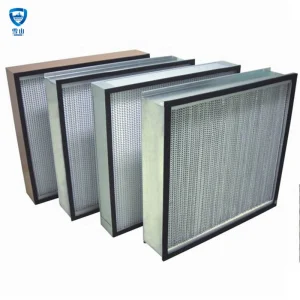
Filters feature high wet-strength beverage board frames (moisture-resistant up to 100% RH), heavy-duty galvanized steel, extruded aluminum, or rigid ABS plastic encasements. All frames are fully sealed with polyurethane adhesives to eliminate internal bypass air leakage.
Advanced Functional Media Innovations
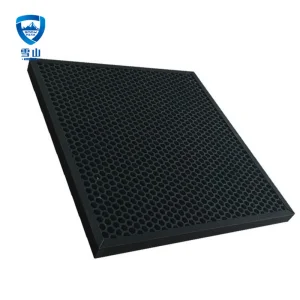
Beyond traditional mechanical particulate capture, custom options include antimicrobial synthetic treatment to prevent bacterial colonization, activated carbon layer lamination for volatile organic compound (VOC) adsorption, and cold-catalyst coatings for gas decomposition.
Target Industrial & Localized Application Matrix
Tailored air filtration engineering is vital across diverse industrial operating environments. China-manufactured pre-pleated filters deliver robust, scalable performance tailored to severe environmental challenges.
Semiconductor Fabs & Cleanrooms
Serves as the primary stage in make-up air units (MAU) and recirculating air handlers (RAH), preventing large particulates from clogging terminal ULPA filters and maintaining ISO Class 3 through Class 8 cleanroom compliance.
Hospitals & Biopharmaceutical Plants
Deployed in critical ventilation systems to capture airborne bio-aerosols, skin flakes, and fungal spores. Helps satisfy cGMP cleanroom guidelines and strict medical ventilation standards (e.g., DIN 1946-4).
Gas Turbine Air Intake Systems
Protects gas turbines, large diesel engines, and industrial air compressors from erosive dust, salt spray, and insect ingestion in power generation, marine, and offshore oil platform setups.
Paint Spray Booths & Surface Finishing
Ensures silicone-free particulate capture in automotive paint lines, capturing overspray particles, dust contaminants, and protecting surface gloss and finish quality.
Smart Office Towers & Data Centers
Integrated into central HVAC setups to provide low-energy, low-noise ventilation. Protects high-density server racks from dust buildup that can cause overheating and electrical short circuits.
Residential & Commercial Purifiers
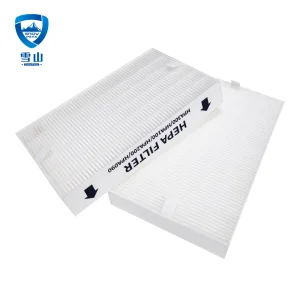
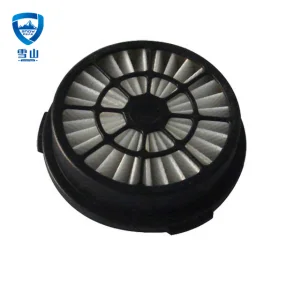
Custom OEM replacement filter modules designed to meet precise physical dimensions, pressure drop limits, and CADR performance specs for global appliance brands.
Quality Control, Localized Support & Compliance Framework
Robust Quality Assurance (QA) and strict international standard compliance are non-negotiable foundations for global OEM partnerships and direct procurement.
Four-Tier Rigorous Quality Control Process
Every manufacturing lot undergoes rigorous inspection: IQC (Incoming Quality Control of raw media, wire, and frames), IPQC (In-Process QC checking pleat counts, hot-melt spacing, and glue integrity), FQC (Finished Quality Control testing dimensions and pressure drop), and OQC (Outgoing Quality Control verifying moisture-proof export packaging).
International Regulatory Certification
Products strictly comply with global fire safety and environmental standards, including UL 900 Class 1 & Class 2 flammability ratings, CE certification, RoHS/REACH chemical safety restrictions, and ISO 9001:2015 quality management system requirements.
Custom OEM/ODM Private Labeling Services
Comprehensive custom manufacturing capabilities include custom frame sizes, non-standard pleat depths (1-inch, 2-inch, 4-inch, and dynamic mini-pleat configurations), high-resolution private brand printing, barcoding, and drop-ship packaging options for international distributors.
Technology Roadmap & Future Outlook
The future of air filtration hinges on advanced smart monitoring integration, sustainable circular media chemistry, and ultra-low pressure drop aerodynamic engineering.
Nanofiber Electrospinning
Application of ultra-thin nanofiber coatings onto spunbond substrates to achieve MERV 14+ performance while drastically reducing initial pressure drop compared to traditional meltblown media.
Biodegradable & Recycled Polymers
Development of 100% bio-based PLA synthetic fibers and recycled PET frames to support carbon-neutral industrial facilities and reduce landfill burden from spent filters.
IoT RFID & Pressure Sensors
Integration of embedded passive RFID tags and dynamic pressure differential sensors into filter frames for real-time filter life telemetry in automated Smart Building Management Systems (BMS).
Net-Zero Aerodynamic Pleats
Advanced computational fluid dynamics (CFD) pleat profiling designed to minimize turbulence and fan brake horsepower, directly contributing to zero-emission building initiatives.


Technical Procurement & Engineering Q&A
Comprehensive answers to essential engineering, purchasing, and manufacturing questions regarding pre-pleated air filters.