







1. Executive Summary & Physics of Activated Charcoal Air Filtration
In modern industrial, commercial, and residential HVAC engineering, particulate matter removal (via HEPA or MERV filtration) addresses only half of the indoor air quality equation. Airborne Molecular Contaminants (AMCs), Volatile Organic Compounds (VOCs), hazardous gases (such as Formaldehyde, Benzene, $NH_3$, $H_2S$, and $SO_x$), and persistent nuisance odors present severe operational and health challenges. Custom activated charcoal air filtration serves as the definitive engineering response to molecular gaseous pollutants.
As a leading custom activated charcoal air filter factory and supplier based in China, our manufacturing facilities engineer specialized gas-phase adsorption media tailored to specific mechanical constraints and environmental chemistry requirements. Activated charcoal functions primarily through Van der Waals physical adsorption (physisorption) enhanced by immense internal pore surface areas (typically ranging from $800 \text{ m}^2/\text{g}$ to over $1,500 \text{ m}^2/\text{g}$).
Pore Structure Matrix & Key Adsorption Indicators
When procuring custom activated charcoal filters for HVAC units, cleanrooms, or OEM air purifiers, procurement teams must evaluate key chemical performance metrics:
- Iodine Number (mg/g): Measures micropore content (0 to 2 nm). High iodine numbers (900–1200 mg/g) indicate superior capacity for low-molecular-weight VOCs and small gas molecules.
- Carbon Tetrachloride Activity (CTC %): Reflects pore volume between 2 and 50 nm. High CTC values (50% to 80%) correspond directly to higher overall solvent vapor and organic gas absorption capacity.
- Hardness / Abrasion Resistance (%): Crucial for air filtration to prevent carbon dust shedding into clean airstreams under high-velocity flow. Our factory enforces a minimum 95% ball-pan hardness rating.
- Apparent Density (g/cm³): Determines bed weight and total carbon loading density per cubic meter of filter structure.
2. Advanced Impregnation Chemistry for Targeted Gas Neutralization
Standard physical adsorption struggles to retain highly volatile polar gases, low-boiling-point compounds, or acidic/alkaline gaseous molecules due to weak physical bonding. To overcome this fundamental physical boundary, our factory applies chemical impregnation (Chemisorption).
Through precise chemical dosing during raw material processing, chemical impregnants are reactively dispersed across the internal pore networks of the activated carbon matrix. When target gases contact the media, a chemical reaction transforms hazardous compounds into stable, non-volatile salts or harmless byproducts.
| Target Gas / Compound | Chemical Catalyst / Impregnant | Adsorption Mechanism | Typical Industrial Application |
|---|---|---|---|
| Acid Gases ($H_2S$, $SO_2$, $Cl_2$, $HCl$) | Potassium Hydroxide ($\text{KOH}$) / Sodium Carbonate ($\text{Na}_2\text{CO}_3$) | Acid-Base Neutralization Forming Stable Sulfate/Chloride Salts | Waste Water Treatment, Petrochemical Plants, Paper Mills |
| Ammonia ($NH_3$) & Alkaline Amines | Phosphoric Acid ($\text{H}_3\text{PO}_4$) / Sulfuric Acid ($\text{H}_2\text{SO}_4$) | Acid-Base Chemisorption Forming Ammonium Salts | Agricultural Facilities, Laboratories, Chemical Synthesis |
| Formaldehyde ($HCHO$) & Low VOCs | Potassium Permanganate ($\text{KMnO}_4$) / Amine Reagents | Catalytic Oxidation to Carbon Dioxide ($\text{CO}_2$) & Water ($\text{H}_2\text{O}$) | New Building HVAC, Automotive Cabins, Home Purifiers |
| Mercury Vapors & Heavy Metals | Sulfur ($S$) or Potassium Iodide ($\text{KI}$) Impregnation | Formation of Stable Mercury Sulfide ($\text{HgS}$) Amalgams | Coal-fired Exhaust, Power Generation, Mining Refining |
| Ethylene & Organic Decomposing Odors | Activated Alumina with $\text{KMnO}_4$ Blend | Irreversible Oxidation & Degradation | Cold Storage Warehousing, Food Logistics, Floriculture |
3. Engineering Form Factors: Custom Carbon Media & Architectural Configurations
Selecting the structural matrix of custom activated charcoal filters requires balancing gas removal efficiency against dynamic static air pressure drop ($\Delta P$). Our manufacturing facility crafts several distinct physical form factors:
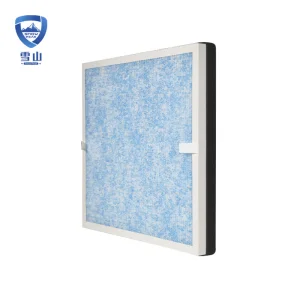
A. Honeycomb Activated Carbon Filters (Aluminum / Paper / Polycarbonate Matrix)
Constructed by filling high-density honeycomb grid structures with micro-granular activated charcoal or bonding carbon directly to cell walls. Offers exceptionally low air resistance, structural rigidity, and uniform face velocity. Ideal for high-airflow HVAC systems and compact desktop air purifiers.
B. Sandwich-Type & Pleated Synthetic Carbon Composite Fabrics
Engineered by laminating fine coconut shell carbon powder (or impregnated carbon particles) between non-woven synthetic fibers. The pleating process multiplies the total filter surface area by 300% to 500%, achieving dual-function filtration: MERV 13 to HEPA H13 particulate capture combined with gas-phase odor control.
C. Extruded Pellet Carbon Trays & V-Bank Modules
Designed for heavy-duty industrial gas scrubbers and cleanroom recirculating air units (RAUs). Utilizes 3mm to 4mm cylindrical extruded carbon pellets housed inside heavy-gauge galvanized steel or stainless steel V-bank frames, maximizing dwell time (contact time) up to 0.1–0.5 seconds.
D. Carbon-Impregnated Open-Cell Polyurethane Foam
Features 10 PPI to 60 PPI (pores per inch) reticulated foam coated with high-activity charcoal slurry. Provides minimal pressure drop, serving as an effective primary pre-filter in air handling units (AHUs).
4. Strategic Advantages of Partnering with China OEM/ODM Charcoal Filter Factories
Navigating global supply chain volatility requires direct integration with specialized, vertically integrated manufacturers. Sourcing custom activated charcoal air filters directly from our China factory delivers distinct technical and financial benefits:
- Integrated Sourcing of Premium Raw Charcoal: We maintain direct access to high-grade coconut shell charcoal from Southeast Asia (boasting superior hardness and high microporosity) alongside premium coal-derived carbon blocks for industrial applications.
- State-of-the-Art Automated Pleating & Slitting Lines: Our production floor utilizes continuous robotic dispensing and ultrasonic bonding lines capable of maintaining a mass loading tolerance of $\pm 2\%$ across carbon non-woven rolls.
- Full Spectrum Testing Compliance: Every batch undergoes testing for pressure drop, CADR (Clean Air Delivery Rate), TVOC single-pass efficiency, and structural integrity according to ISO 16890, EN 779, ASHRAE 52.2, and GB/T 18801-2022 standards.
- Rapid Prototyping & Custom Tooling: We provide engineering design validation, 3D prototype modeling, and custom frame injection molding within 5 to 7 working days.
5. Global Application Scenarios & Macro Industry Solutions
Our custom activated charcoal filters are deployed across critical macro-industrial sectors globally:
Semiconductor Cleanrooms
Prevention of Airborne Molecular Contaminants (AMCs) including organic silicones, acids, and dopants that corrupt wafer fabrication down to sub-nanometer nodes.
Commercial HVAC & Smart Buildings
Mitigation of urban smog, nitrogen dioxide ($NO_2$), sulfur dioxide ($SO_2$), and outdoor diesel exhaust fumes entering building intake systems.
Automotive Cabin Filters
OEM multi-layer pleated carbon filters protecting vehicle occupants from road tunnel pollutants, exhaust odors, and agricultural allergens.





