
High-Performance Filtration Solutions
Explore our certified cabin, cleanroom, and HVAC air filtration products custom engineered for global automotive, commercial, and industrial operations.

Wholesale High Efficiency HEPA Filters from China Suppliers - Customized for Air Purifiers & Vacuum Cleaners
View Product Specs
OEM Honeywell HRF-R3 HEPA R Replacement Filter: Compatible with HPA300 Series, HPA304, HPA3300
View Product Specs
CE Certification China Activated Carbon Fabric Air Filter Material for Efficient Particle and Odor Removal
View Product Specs
China Customized Top Side Gel Seal Liquid Tank Mini Pleated Compact HEPA Filter for Clean Room
View Product Specs
China High Efficiency Customized Size Mini-Pleated HEPA HVAC Industrial Air Filter
View Product Specs
Wholesale Painting Room Filters 600G Ceiling Filter Cotton G4 M5 Pre-Medium Efficiency Material
View Product Specs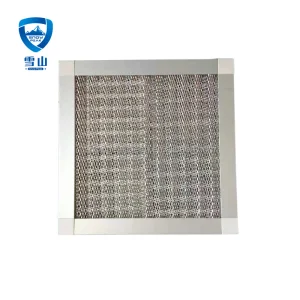
Wholesale Metal Washable Metallic Mesh Primary Air Filter Stainless Steel Industrial Filter
View Product Specs
China Foldable Activated Carbon & H13 HEPA Replacement Filter for Blueair Blue Pure 211+
View Product SpecsThe Macro Evolution of In-Cabin Air Quality Architecture
How transition to Electric Vehicles (EVs) and smart mobility is reshaping gaseous pollutant abatement and HVAC air filtration requirements.
EV Micro-Climate Management
Electric vehicle architectures demand hyper-efficient thermal and air management. Traditional ICE vehicles relied on surplus waste heat, whereas EV HVAC systems consume traction battery energy. Cabin air filters must maintain exceptional ultra-low pressure drop (ΔP) to minimize blower motor power consumption while delivering maximum Clean Air Delivery Rates (CADR) for toxic gaseous contaminants.
Gaseous & VOC Abatement
Modern cabin air filtration has expanded beyond coarse PM10 dust capture. In-cabin atmosphere risks include harmful Volatile Organic Compounds (VOCs) such as benzene, toluene, formaldehyde, nitrogen dioxide ($\text{NO}_2$), sulfur dioxide ($\text{SO}_2$), and ground-level tropospheric ozone ($\text{O}_3$). Custom activated charcoal media binds these molecular pollutants via chemical adsorption and physical physisorption.
Bio-Defense & HEPA Integration
Automotive OEMs and aftermarket brands are moving toward multi-stage hybrid filters combining True HEPA (H13/H14 grade) media with high-density activated carbon matrices. This composite architecture achieves up to 99.97% efficiency against sub-micron viral carriers (0.3 $\mu\text{m}$) while simultaneously eliminating offensive odors and hazardous gas surges.
Activated Charcoal Matrix Technology
A rigorous comparison of raw material substrates, activation methods, pore distribution, and catalytic impregnations for optimal gas retention.
| Activated Carbon Material Source | BET Surface Area ($\text{m}^2/\text{g}$) | Micro-Pore Ratio (< 2 nm) | CTC Adsorption Value (%) | Primary Air Filtration Application |
|---|---|---|---|---|
| Virgin Coconut Shell Charcoal | 1,100 – 1,450 | 85% - 90% | 60% - 75% | High-velocity cabin VOC, odor, and light molecular gas adsorption. |
| Bituminous Coal Charcoal | 850 – 1,050 | 55% - 65% | 45% - 55% | Industrial HVAC pre-filtration, heavy diesel soot & exhaust gases. |
| Synthetic/Wood-Based Carbon | 1,200 – 1,600 | 40% - 50% (Meso-dominated) | 70% - 90% | High-capacity formaldehyde ($\text{HCHO}$) & complex toxic gas adsorption. |
| Chemically Impregnated Carbon (KOH/Metal Oxides) | 950 – 1,200 | Targeted Catalytic Impregnation | 50% - 65% | Acidic gas neutralization ($\text{SO}_2$, $\text{NO}_x$, $\text{H}_2\text{S}$) in mining & agriculture. |
Pore Network Optimization
Adsorption capacity is governed by pore size distribution. Micro-pores (< 2 nm) capture smaller gas molecules like benzene and butane via Van der Waals forces, while meso-pores (2–50 nm) transport bulk vapors. Our custom formulation optimizes the micro-to-meso ratio for instantaneous residence-time adsorption.
Chemically Active Impregnation
Physical adsorption alone cannot permanently lock light, non-polar gases. By chemically impregnating activated charcoal with potassium hydroxide ($\text{KOH}$), zinc salts, or copper catalysts, our filters convert dangerous sulfur dioxide and ammonia into non-volatile stable chemical salts via chemisorption.
Composite Lamination Tech
Using thermal point-bonding nonwoven techniques, activated carbon granules are locked between dual synthetic meltblown electret layers. This prevents carbon particle shedding, avoids channeling, and ensures uniform mass loading across the entire filter face area.
International Standards & Quality Benchmarks
Our manufacturing lines operate under strict quality frameworks to fulfill Tier-1 automotive and global industrial regulatory specs.
ISO 11155-1 & 11155-2 Validation
Full compliance with international test methods for cabin air filters. Part 1 measures particulate filtration efficiency using standardized A2 Fine Dust, while Part 2 measures dynamic gas adsorption capacity against n-butane, toluene, sulfur dioxide, and nitrogen oxides under controlled airflow velocities.
VDA 270 Odor Testing Protocol
Ensuring zero outgassing from filter frames, adhesives, and raw media. All activated charcoal cabin filters undergo rigorous sensory evaluation under elevated thermal and humidity conditioning (80°C) to guarantee neutral, odor-free air delivery into the vehicle interior.
EN 15695 Category 4 Cabins
Engineered for heavy agricultural machinery and specialized industrial cabs. Category 4 protection mandates total isolation from hazardous airborne dust, aerosols, and pesticide vapor risks via multi-pass chemical carbon beds and certified HEPA elements.
Full OEM & ODM Turnaround Capabilities
From CAD modeling and rapid rapid prototyping to automated pleating and mass production continuous assembly lines.
Automated Blade & Rotary Pleating
Our computerized pleating lines ensure high pleat-geometry consistency with precise pleat spacing and depth control (from 10 mm to 65 mm). Built-in hot-melt glue beads prevent pleat collapse under high dynamic air velocities.
Flexible Frame Construction
Custom edge-sealing options including nonwoven side tapes, rigid injection-molded plastic housings, elastomeric Polyurethane (PU) foam gaskets, and flexible sponge borders for 100% bypass-free HVAC slot seating.
Precision Weight-Loading Control
Online gravimetric sensors continually inspect charcoal mass loading ($\text{g}/\text{m}^2$). Carbon loading tolerances are maintained within $\pm 3\%$, preventing airflow imbalance while offering guaranteed gas adsorption lifetime.
Tailored Filtration for Every Operating Environment
Optimized filter media engineering targeted at specific regional climates, vehicle types, and industrial environments.
Urban Passenger & Taxi Fleets
High-stop urban driving subjects occupants to elevated traffic exhaust emissions ($\text{NO}_2$, diesel particulates, and unburnt hydrocarbons). Our high-density coconut charcoal filters absorb street-level odors instantly while preventing driver fatigue from volatile exposures.
Mining & Earthmoving Machinery
Off-highway operators in heavy mining and construction sites face abrasive mineral dust and sulfurous engine fumes. Heavy-duty activated charcoal cabin filters reinforced with steel wire mesh backing withstand intense vibration and continuous dusty airflow.
Electric Transit Buses & Rail
Public transportation systems require ultra-reliable HVAC filtration with high airflow rates ($> 1000\text{ m}^3/\text{h}$). Large-format pleated activated carbon modules deliver continuous air sanitation for high passenger density without overloading HVAC blowers.
Traceable & Certified Manufacturing Quality
Eliminating procurement risk with rigorous material verification, in-line testing, and global export packaging support.
1. IQC Raw Material Testing
Every shipment of nonwoven fabric, meltblown media, and granular activated charcoal undergoes strict Incoming Quality Control. Carbon moisture content, particle mesh distribution, and BET surface area are verified before entering production.
2. In-Line IPQC Verification
Automated visual inspection system checks pleat alignment, hot-melt string spacing, adhesive coverage, and dimensional squareness during high-speed lamination and pleating assembly.
3. FQC & OQC Final Testing
Finished filter batches are randomly sampled for dynamic pressure drop ($\Delta P$) testing, aerosol penetration analysis, and moisture resistance before vacuum-sealed barrier packaging.
Next-Generation Filtration Technologies
Pioneering tomorrow's smart, self-regenerating, and ultra-sustainable in-cabin air filtration systems.
Electrostatic & Carbon Matrix
Synthetic meltblown electret media combined with high-CTC coconut shell charcoal for dual PM2.5 and VOC capture.
Cold Catalyst & Photocatalysis
Integrating ambient-temperature catalytic coatings to breakdown formaldehyde ($\text{HCHO}$) continuously into water and carbon dioxide without carbon saturation.
RFID & Differential Pressure Chips
Integrating smart RFID tags and embedded micro-sensors to provide real-time filter life indicators to electric vehicle infotainment units.
Bio-Based Polymers & Recycled Carbon
Developing fully biodegradable PLA nonwoven media frames and closed-loop regenerated carbon matrices for carbon-neutral auto manufacturing.
Custom Cleanroom & Industrial Replacement Media
Explore additional high-efficiency filter media rolls, cleanroom gel-seal filters, and private label replacement solutions.
Custom Customized Gel Seal HEPA Filter for Clean Rooms - High Efficiency Air Filtration
View Product Specs
China Pocket Air Filter Media G4 M5 M6 F7 F8 F9 - High-Quality Bag Filter Roll Media
View Product Specs
Wholesale Pocket Air Filter Media G4 M5 M6 F7 F8 F9 Bag Air Filter Roll Media Exporters
View Product Specs
Custom China Suppliers HEPA Filter Mini-Pleated Activated Carbon Air Filter for VOC and PM2.5 Removal
View Product Specs
Custom Honeywell HPA100 HEPA Filter Replacement | True H13 HEPA HRF-AP100 Factories
View Product Specs
China G2 G3 G4 Air Filter Roll Material - Green White Synthetic Fiber Suppliers & Factory
View Product Specs
High-Quality High-Efficient Activated Carbon Media with Wire Mesh for Pleated Filters
View Product Specs
OEM China Supplier Honeycomb Activated Carbon Filter for Odor and Harmful Gas Removal
View Product SpecsFrequently Asked Questions by B2B Procurement Teams
Direct technical answers regarding carbon loading, dynamic testing, custom tooling, MOQ, and international certifications.