
Featured Industrial Air Cleaners & Replacement Filters
Engineered for high dust holding capacity, ultra-low initial resistance, and strict compliance with global filtration standards.



Global Commercial & Industrial Air Filtration Reality
Analyzing macro-market dynamics, regulatory headwinds, and energy-efficiency demands driving modern HVAC & cleanroom design.
The global demand for high-efficiency particulate air (HEPA) systems and custom industrial air cleaner solutions has entered a transitional phase. Driven by escalating ambient particulate pollution, stringent occupational safety laws, and the exponential growth of microelectronics, pharmaceutical biotechnology, and advanced battery manufacturing, industrial air filtration has evolved from a routine building utility into a critical operational asset. Procurement directors and facility managers no longer evaluate filters solely on initial purchase price; instead, the industry has shifted toward evaluating total cost of ownership (TCO), lifecycle energy consumption, structural reliability under variable airflow rates, and precise compliance with updated international standards such as EN 1822:2019 and ISO 29463.
In heavy industrial environments, cleanrooms, data centers, and bio-containment facilities, particulate contamination represents a direct threat to yield rates, process stability, and personnel health. Microscopic airborne particles—ranging from sub-micron sub-0.3µm aerosolized droplets to larger mineral dusts—require engineered multi-stage separation systems. A failure to specify the exact media composition, pleat geometry, frame structural integrity, or sealing mechanism can result in severe pressure drop penalties, bypass leakage, or premature filter loading, ultimately inflating facility energy usage by up to 40%.
| Filtration Standard Grade | Test Particle Size (MPPS) | Minimum Retention Efficiency | Primary Industrial Application | Seal & Frame Architecture |
|---|---|---|---|---|
| ISO 35 E / EPA E11 | 0.3 µm | ≥ 95.0% | Commercial AHU, Pre-filtration, Food Prep | Gasket Seal / Galvanized Steel |
| HEPA H13 (EN 1822) | 0.3 µm / MPPS | ≥ 99.95% | Pharma Cleanroom, Hospital Operating Rooms | Gel Seal / Anodized Aluminum |
| HEPA H14 (EN 1822) | 0.3 µm / MPPS | ≥ 99.995% | Semiconductor Fabrication, BIBO Exhaust | Fluid Gel Seal / Stainless Steel |
| ULPA U15 (EN 1822) | 0.12 µm / MPPS | ≥ 99.9995% | Nanotechnology, Precision Optics, ISO Class 1 | Knife-edge Liquid Tank / Extruded Al |
Technical Roadmap & Micro-Structural Engineering
A deep dive into media physics, fluid mechanics, sealing dynamics, and smart IoT maintenance integrations.
Industrial HEPA filters do not act as simple mechanical sieves. Instead, particulate capture relies on four distinct physical mechanisms working simultaneously across sub-micron and macro particle spectrums:
- Impaction: Inertia causes large particles (>1.0µm) to collide directly with fibers at high air velocity.
- Interception: Medium particles (0.3µm - 1.0µm) follow air streamlines and touch fiber boundaries.
- Diffusion: Brownian motion governs sub-0.1µm ultra-fines, creating erratic paths that increase collision probability.
- Electrostatic Attraction: Charged synthetic fibers capture fine aerosols with ultra-low initial pressure drop.
Choosing between wet-laid borosilicate glass microfiber and expanded Polytetrafluoroethylene (ePTFE) dictates physical durability and energy expenditure:
- Borosilicate Glass: Offers maximum dust-holding capacity (DHC), chemical inertness, and high temperature tolerance up to 250°C.
- ePTFE Membrane: Delivers up to 40% lower initial pressure drop ($\Delta P$), zero off-gassing for semiconductor cleanrooms, and robust mechanical tear strength.
Air bypass represents the primary point of failure in cleanroom ventilation. Modern industrial supply demands dual-seal integrity:
- Fluid Gel Seal: Polyurethane or silicone gel channels accommodate knife-edge grid housings, self-healing under thermal expansion.
- Continuous Seamless Gaskets: Robotically dispensed polyurethane gaskets eliminate corner joints where bypass leaks originate.
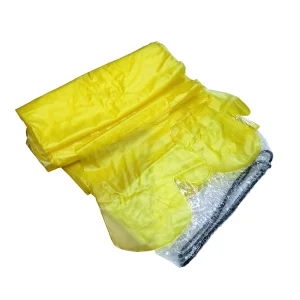
- BIBO Containment: Integrated PVC containment bags allow hazardous zero-exposure filter replacements in toxic or biohazard exhaust ducts.
The Smart Industrial Filtration Roadmap (2025–2030)
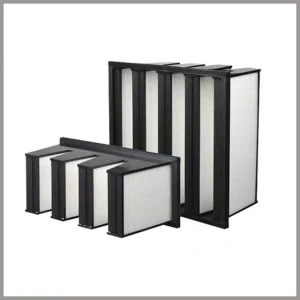
The next decade of industrial air purification centers on digital connectivity and active performance optimization. Traditional scheduled filter replacements are being rapidly replaced by IoT-driven predictive maintenance models. By embedding differential pressure transducers, air velocity sensors, and optical particle counters directly into V-bank and mini-pleat filter frames, facility engineers can monitor filter loading in real time. Algorithms analyze $\Delta P$ degradation curves to predict remaining useful life (RUL), preventing premature filter disposal while safeguarding HVAC blowers against excessive backpressure.
Localized Application Scenarios & Engineering Integration
Custom industrial HEPA air cleaner configurations tailored to rigorous operational conditions across global facility environments.
In microelectronics fabrication (ISO Class 1 to 5), sub-micron particles cause micro-shorts and wafer defects. Customized gel-seal mini-pleat HEPA/ULPA units deliver ultra-uniform laminar airflow with zero boron or organophosphorus outgassing, protecting sensitive EUV lithography equipment.
Aseptic filling suites and biosafety level (BSL-3/4) laboratories demand complete microbial containment. Stainless steel V-bank HEPA systems integrated with Bag-In/Bag-Out (BIBO) housings allow maintenance technicians to swap out contaminated filters without exposing workers or the surrounding community to harmful pathogens.
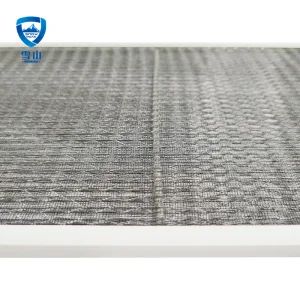
Gas turbine air intakes in coastal or desert environments face extreme dust loads and salt aerosols. Heavy-duty pulse-jet cleanable pre-filters coupled with hydrophobic H13 final filters preserve compression efficiency and prevent severe turbine blade erosion and fouling.
Ultra-clean surgical environments rely on ceiling-mounted gel-seal HEPA modules to create a sterile positive-pressure down-draft over surgical fields, maintaining airborne bacterial colony-forming unit (CFU) counts well below regulatory infection control thresholds.
Corrosive airborne gases (sulfur compounds, chlorine) and microscopic dust can lead to server circuit board whiskering and thermal throttling. Dual-stage molecular gas-phase carbon beds combined with high-capacity MERV13–H13 filters ensure continuous 24/7 uptime for critical cloud infrastructure.
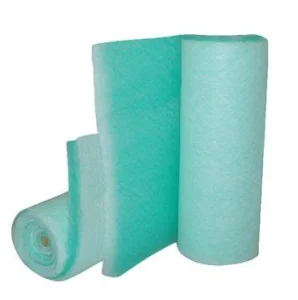
High-end automotive finishing requires zero paint-crater defects caused by airborne dust larger than 5 microns. Progressive-density glass fiber floor rolls and high-temperature ceiling diffusion filters provide heat resistance, flame retardance, and uniform air distribution.
China Supply Chain Resilience & Shenzhen Manufacturing Efficiency
Leveraging deep industrial clusters, automated manufacturing, and full-spectrum quality testing to power global supply chains.
Navigating global supply chain volatility requires sourcing partners that offer structural flexibility, vertical media integration, and rapid lead-time predictability. Operating from the world-class electronics and precision technology hub of Shenzhen, China, our manufacturing infrastructure provides B2B buyers, distributor chains, and OEM purifier manufacturers with unmatched supply chain resilience.
Unlike regional assemblers that rely on fragmented third-party component sourcing, our facility maintains end-to-end control over the production lifecycle—from non-woven meltblown formulation and glass fiber media pleating to automated frame extrusion, polyurethane dispensing, and unit-level leak scanning.
The 4-Stage Quality Control Architecture (IQC → IPQC → FQC → OQC)
To ensure zero defect rates during global container transit, every industrial HEPA unit and OEM replacement filter is subjected to a strict 4-stage quality management matrix:
- IQC (Incoming Quality Control): Micro-fiber media is tested for weight ($g/m^2$), tensile strength, thickness, and initial pressure drop before entering production lines.
- IPQC (In-Process Quality Control): Laser-guided pleating machines continuously monitor pleat spacing, hot-melt bead alignment, and frame squareness.
- FQC (Final Quality Control): High-efficiency cleanroom filters undergo 100% automated particle scanning (DOP/PAO challenge aerosols) to guarantee zero pinpoint pinhole leaks across the entire filter face.
- OQC (Outbound Quality Control): Drop-test verified export packaging ensures moisture-proof, vacuum-sealed protection during long-distance maritime freight.
Localization Support & Regulatory Compliance Assurance
Full alignment with North American, European, and Asia-Pacific environmental safety standards and private-label requirements.
Our filtration products comply with major global environmental and safety frameworks, including CE Certification, RoHS Compliance (restricting hazardous substances), and REACH Registration. This ensures seamless customs clearance and regulatory approval for overseas distributors.
We provide full turn-key private label customization for industrial distributors and e-commerce brand owners. Services include custom dimensional sizing, branded frame stamping, custom retail-ready packaging, barcode integration, and tailored efficiency test certificates inside every carton.
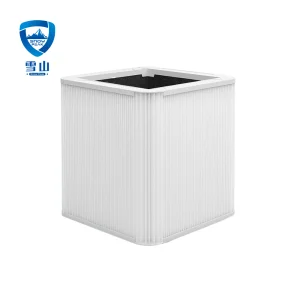
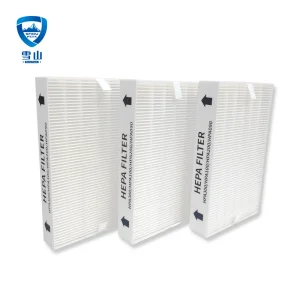
In addition to heavy industrial HVAC units, our factory manufactures premium aftermarket replacement filters compatible with world-leading home and commercial air purifier brands (Honeywell, Blueair, Coway, Levoit, Germ Guardian)—offering OEM-grade fit and performance at scale.
Specialty Cleanroom & Custom Media Products
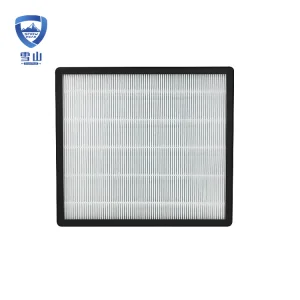
Explore our specialized range of liquid-tank gel filters, carbon gas adsorption media, and industrial filter rolls.




Industrial HEPA Technical FAQ & Procurement Guide
In-depth engineering answers addressing common technical queries from industrial buyers and plant engineers.
Accelerate Your Industrial Filtration Supply Chain
Partner with Shenzhen's premier high-tech air filtration factory for custom OEM prototyping, competitive volume pricing, and guaranteed EN 1822 compliant production.
Request Engineering Quotation & Custom Samples