
Featured Large Air & Gas Filtration Systems
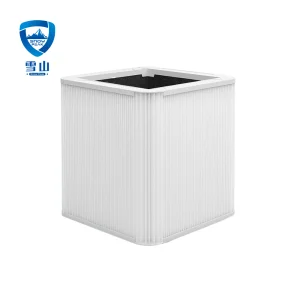
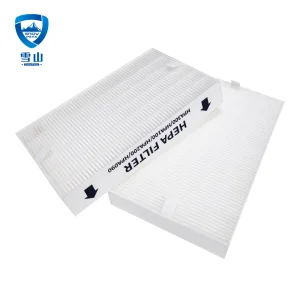
Explore our factory-engineered activated carbon solutions, HEPA composite units, and custom cleanroom filtration modules.






1. Global Industrial Landscape & Market Dynamics for Large Carbon Filters
The global demand for large carbon air filter systems has experienced an unprecedented surge driven by rigorous environmental mandates, advancing cleanroom requirements in semiconductor fabrication, and heightened awareness of indoor air quality (IAQ) in mega-commercial infrastructures. Modern industrial manufacturing processes yield complex gas-phase contaminants—ranging from volatile organic compounds (VOCs), formaldehyde, hydrogen sulfide ($H_2S$), sulfur dioxide ($SO_2$), to airborne molecular contamination (AMC)—that cannot be neutralized by traditional particulate filters alone.
As an established carbon filter manufacturer and global factory supplier, we observe key structural shifts across North American, European, and Asia-Pacific markets. Global regulatory frameworks, such as the EU REACH standards and US EPA Clean Air Act amendments, mandate aggressive abatement of industrial gaseous emissions. Consequently, facility managers and original equipment manufacturers (OEMs) require scalable, high-capacity adsorption architectures capable of managing massive volumetric airflows ($3,000 \text{ to } 50,000+ \text{ m}^3/\text{h}$) without causing excessive system static pressure drops.
2. Adsorption Mechanics: Physical vs. Impregnated Chemisorption Matrices
Selecting a high-efficiency large carbon air filter supplier requires a thorough comprehension of chemical kinetics, pore geometry, and target molecule interactions. Activated carbon filters operate through two distinct thermodynamic mechanisms:
Physisorption (Physical Adsorption)
Governed by van der Waals forces, physical adsorption condenses gas molecules inside micropores (<2 nm diameter). Ideal for non-polar, high-molecular-weight VOCs like Benzene, Toluene, Xylene, and long-chain hydrocarbons. Pore volume and BET surface area are the primary performance metrics.
Chemisorption (Chemical Impregnation)
Targeted for low molecular weight, highly polar or acidic/alkaline gases that cannot be physically trapped. Carbon granules are chemically impregnated with compounds like Potassium Hydroxide (KOH) for acid gas neutralization ($H_2S$, $SO_2$), Phosphoric Acid ($H_3PO_4$) for Ammonia ($NH_3$), or Potassium Permanganate ($KMnO_4$) for Ethylene degradation.
Hybrid Catalyst-Carbon Composites
Combines cold catalyst substrates with microporous carbon structures. Enables simultaneous catalytic oxidation of Formaldehyde ($HCHO$) into $H_2O$ and $CO_2$ at room temperature while maintaining continuous VOC capture capacity without early saturation.
Engineering Note: Mass Transfer Zone (MTZ) & Residence Dwell Time
For industrial carbon beds, airflow velocity must be calibrated to ensure adequate Bed Residence Time (Dwell Time)—typically between 0.1 to 2.0 seconds. If velocity exceeds design thresholds, the Mass Transfer Zone extends beyond the bed depth, resulting in premature gas breakthrough despite unexhausted total carbon capacity.
Technical Specification Comparison: Carbon Substrates & Media Formats
| Substrate / Carbon Type | Iodine Value (mg/g) | CTC Rating (%) | Primary Pore Structure | Target Pollutant Spectrum |
|---|---|---|---|---|
| Virgin Coconut Shell | 1000 - 1350 | 65 - 90% | Micro-porous (< 2nm) | Low-concentration VOCs, Odors, Solvents, Ozone |
| Coal-Based Extruded (Pelletized) | 800 - 1050 | 50 - 75% | Meso-porous (2 - 50nm) | High-volume industrial process gases, HVAC VOCs |
| Impregnated KOH/KI Carbon | 750 - 950 | 45 - 60% | Chemically Functionalized | Hydrogen Sulfide ($H_2S$), Acid Gases, Mercaptans |
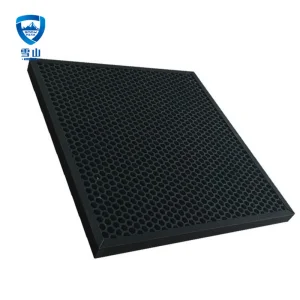
| Honeycomb Carbon Matrix | 600 - 900 | 40 - 55% | Structured Flow Channels | Ultra-low resistance, high-velocity exhaust systems |
| Carbon Polyurethane / Fabric Media | 400 - 700 | 30 - 45% | Non-woven Composite Layer | Pre-filtration, residential purifiers, lightweight HVAC |
3. Structural Architecture of Large-Scale Industrial Air Carbon Filters
Industrial carbon filters differ radically from lightweight residential units. In heavy commercial HVAC, cleanroom intake arrays, and manufacturing exhaust scrubbers, structural integrity determines operational uptime. Our factory utilizes specialized automated assembly lines to produce rigid, leak-proof designs tailored to high CFM (Cubic Feet per Minute) requirements:
1. V-Bank Rigid Cell Assemblies
Constructed using galvanized steel, stainless steel, or high-impact ABS frames housing multiple pleated carbon packs or loose-fill bed trays. V-bank engineering maximizes surface area by up to 300% compared to flat panels, significantly lowering resistance to airflow.
2. Deep-Bed Canister & Cylinder Systems
Heavy-duty steel canisters filled with extruded 3mm or 4mm carbon pellets. Designed for heavy gas loading in chemical plants and wastewater facilities where quick-release bayonet fittings enable rapid media exchange during maintenance routines.
3. Gel-Seal & Liquid Tank Cleanroom Formats
For microelectronics and semiconductor fabrication facilities, carbon units are integrated alongside mini-pleated HEPA filters with polyurethane gel-seal grooves to ensure zero-bypass containment of airborne organic molecular contaminants (AMC).
Zero-Bypass Technology & Frame Construction
Even a 0.1% air bypass leak can degrade gas removal efficiency by over 30%. Our factory integrates continuous polyurethane foam gaskets, seamless perimeter potting, and laser-welded stainless frames to guarantee zero bypass under maximum system static pressure.
4. Macro Sector Solutions: Tailored Technical Deployments
As an experienced OEM supplier, we tailor filter media formulations and frame geometries to meet specific environmental and industrial standards across diverse global sectors:
A. Semiconductor & Lithium Battery Cleanrooms
Challenge: Trace concentration of Siloxanes, N-Methyl-2-pyrrolidone (NMP), and acidic vapors cause catastrophic wafer defects or battery cell contamination.
Solution: Custom multi-stage chemical filter banks utilizing synthetic impregnated carbon with ultra-low outgassing binders, validated via GC-MS testing.
B. Airport Terminal & Commercial HVAC Systems
Challenge: High volumes of jet fuel exhaust ($SO_x$, $NO_x$), kerosene vapors, and ambient city smog entering ventilation systems.
Solution: High-velocity V-bank synthetic carbon media units offering low differential pressure drop (<50 Pa at 2.5 m/s face velocity) to optimize HVAC fan energy consumption.
C. Paint Spray Booths & Chemical Processing
Challenge: Heavy VOC loading (Toluene, MEK, Acetone) combined with high particulate overspray.
Solution: Dual-stage systems featuring G4/M5 pre-filter cotton integrated with deep-bed honeycomb activated carbon modules engineered for high solvent storage capacity.
5. Technology Roadmap & Future Trends in Gas-Phase Filtration (2025–2035)
The gas-phase filtration sector is undergoing rapid modernization driven by material science innovations and smart facility automation. Strategic buyers must evaluate suppliers based on their technical roadmap and alignment with next-generation technologies:
Metal-Organic Frameworks (MOFs)
Next-generation hybrid porous crystalline materials integrated into activated carbon matrices. MOFs deliver up to 5x higher selective adsorption capacity for targeted polar molecules like Ammonia ($NH_3$) and Nitrogen Dioxide ($NO_2$) compared to conventional carbon.
IoT & Breakthrough Sensor Arrays
Smart carbon banks featuring embedded photoionization detectors (PID) and real-time gas sensor arrays. Automatically monitors Mass Transfer Zone advancement, sending predictive signals to facility managers before total bed saturation occurs.
Circular Reactivation & Bio-Carbon
Transitioning toward bio-based carbon sources derived from agricultural residues combined with high-efficiency thermal reactivation protocols, reducing the life-cycle carbon footprint of industrial filtration media by over 40%.
Complete Range of OEM Air Filter Media & Industrial Units
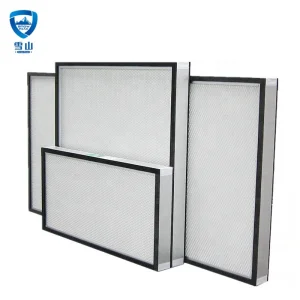
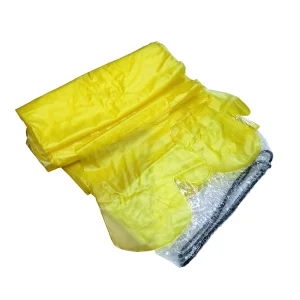
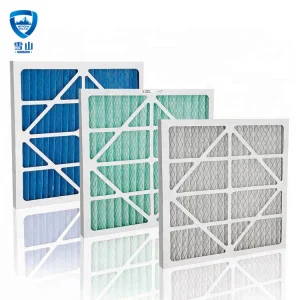
Direct factory supply for pocket filters, mini-pleats, custom media rolls, and specialized protective bags.


6. B2B OEM Procurement & Quality Verification Protocols
Procuring large carbon air filters from China suppliers and manufacturing factories requires rigorous quality verification to prevent field failures and regulatory non-compliance. Our production facilities follow strict ISO 9001 quality management standards alongside a multi-stage Quality Assurance (QA) framework:
1. IQC (Incoming Quality Control)
Every shipment of raw coconut shell or coal-based carbon undergoes ASTM D2867 (Moisture), ASTM D2866 (Ash content), and ASTM D4607 (Iodine Number) testing before entering processing lines.
2. IPQC (In-Process Quality Control)
Automated carbon density monitoring during bed filling prevents voids and settling. Automated pleating lines check pleat spacing and hot-melt adhesive ribbon integrity continuously.
3. FQC & OQC Verification
Finished filter assemblies are tested for initial pressure drop, air leakage under ISO 16890 / EN 779 protocols, and structural shear strength before export packaging.
Frequently Asked Technical Questions (FAQ)
Engineering insights regarding carbon filter specification, sizing, replacement cycles, and custom OEM capabilities.