



Industrial Whitepaper: The Evolution of OEM Activated Charcoal Air Filtration
In modern industrial and commercial environments, particulate filtration alone via HEPA or coarse media is fundamentally insufficient to guarantee air purity. Airborne Molecular Contamination (AMC), Volatile Organic Compounds (VOCs), acidic gases ($SO_2$, $NO_x$, $H_2S$), bio-aerosols, and industrial processing odors demand advanced gas-phase adsorption dynamics. As a premier high-tech enterprise with over 15 years of air purification engineering mastery, Shenzhen Snow Peak Clean Technology Co., Ltd. stands at the forefront of custom carbon matrix engineering, delivering advanced OEM/ODM solutions to global distributors, system integrators, and brand owners across 50+ countries.
Activated charcoal (activated carbon) serves as the primary sorbent for gas-phase filtration due to its extraordinarily vast internal surface area—typically ranging from 800 to 1,500 m²/g. Under electron microscopy, a single gram of activated carbon exhibits a complex, interconnected network of micro-porous (<2 nm), meso-porous (2–50 nm), and macro-porous (>50 nm) domains. Modern OEM activated charcoal air filtration involves far more than simply filling a frame with carbon granules; it requires microscopic porous balancing, pore-size distribution matching to target gas molecular kinetic diameters, chemical impregnation vectoring, and aerodynamic pleating to optimize Carbon Tetrachloride (CTC) values while minimizing initial pressure drop ($\Delta P$).
Global Commercial & Industrial Status: Strategic Trends (2025–2035)
The global demand for activated charcoal air filtration equipment is undergoing a structural transformation. Driven by stringent occupational safety regulations (such as OSHA TVOC exposure guidelines, EU REACH regulations, and ASHRAE Standard 62.1 indoor air quality mandates), commercial HVAC and industrial processing facilities are transitioning from static mechanical filtration to dynamic multi-stage hybrid systems.
1. Semiconductor & Cleanroom AMC Abatement
In microelectronics and photolithography facilities, sub-nanometer airborne molecular contaminants (AMCs) like organic siloxanes, organophosphates, and dopants cause fatal wafer defects. OEM activated carbon filters utilizing specialized chemical impregnants (e.g., acid-impregnated for ammonia, base-impregnated for $SO_2$) provide near-zero breakthrough levels critical for sub-3nm chip fabrication lines.
2. Healthcare, Isolation & Biopharmaceutical
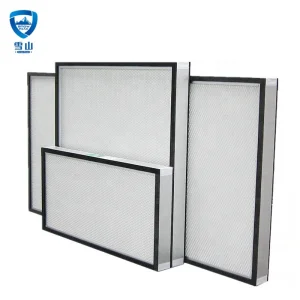
Hospital isolation wards, oncology compounding pharmacies, and pathology laboratories generate elevated concentrations of toxic chemical vapors (formaldehyde, xylene, anesthetic gases). Custom compound carbon-HEPA structures ensure simultaneous 99.97% particulate arrestance and total gaseous VOC adsorption.
3. Automotive Cabin & Commercial Fleet HVAC
The automotive tier-1 supply chain rapidly mandates multi-layer carbon media rolls and pleated cabin filters capable of stripping harmful urban road exhaust pollutants, including $NO_2$, benzene, and particulate matter (PM2.5), before entering passenger spaces.
Technical Roadmap: Physical vs. Chemisorption Form Factors
Achieving superior information gain in air filtration engineering requires a clear mapping of physical sorbents versus reactive chemisorption matrices. Snow Peak's OEM manufacturing process leverages five distinct carbon form vectors depending on customer airflow, static pressure allowance, and chemical target profile:
| Form Vector / Matrix | Physical Pore Characteristics | Typical Impregnation Agents | Optimal Application Scenario | Pressure Drop ($\Delta P$) Profile |
|---|---|---|---|---|
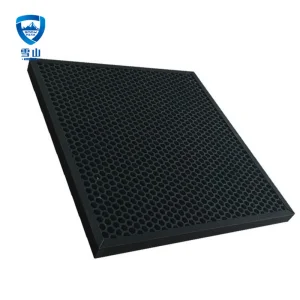
| Honeycomb Carbon Matrix | Macro/Meso-porous channels; 100-300 CPSI cell density | Untreated, KOH, KI, $H_3PO_4$ | High airflow, low noise commercial air purifiers & HVAC units | Ultra-Low (<25 Pa @ 1.5 m/s) |
| Extruded Carbon Pellets | High microporosity; CTC 60%–105%; 1.5mm–4.0mm diameter | Cu-Zn-Mo catalytic complexes, Potassium Permanganate | Heavy industrial gas scrubbers, municipal wastewater odor control | Medium to High (50–150 Pa) |
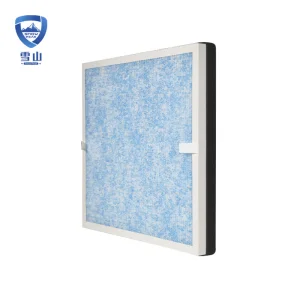
| Carbon Impregnated Non-Woven | Surface functionalized synthetic fibers; light carbon loading | None / Surface Active Catalysts | Pre-filter stages, automotive cabin filters, vacuum cleaner exhausts | Low (15–35 Pa @ 1.0 m/s) |
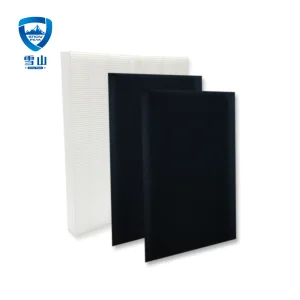
| Composite Carbon Meltblown (HEPA) | Hybrid electrostatic fiber layer fused with micro-granules | Antibacterial silver ions, cold catalysts | Medical purifiers, residential dual-action replacement filters | Balanced (30–60 Pa @ face velocity) |
| Polyurethane Foam Matrix | Open-cell reticulated foam loaded with granular carbon | Base/Acid modified surface chemistry | Industrial machinery intakes, electronic enclosure protection | Very Low (<20 Pa) |
Understanding Chemisorption vs. Physical Adsorption Kinetics
Physical adsorption relies strictly on weak van der Waals forces. While physical activated charcoal is exceptionally effective for high-molecular-weight VOCs (such as benzene, toluene, and long-chain hydrocarbons), it exhibits poor affinity for low-molecular-weight polar compounds like formaldehyde ($HCHO$), hydrogen sulfide ($H_2S$), and ammonia ($NH_3$).
To overcome this thermodynamic limitation, Snow Peak integrates targeted chemisorption technology. Chemical reagents are molecularly bonded inside the carbon pores. When contaminant gases pass through, chemical reactions instantly neutralize or transform toxic molecules into harmless, non-volatile solid salts. For instance, Potassium Hydroxide (KOH) impregnation yields rapid oxidation of acidic gases:
H₂S + 2 KOH + 2 O₂ → K₂SO₄ + 2 H₂O
Snow Peak OEM Engineering Architecture & Custom Capabilities
Sourcing custom activated charcoal filters demands extreme manufacturing precision to prevent channel bypass, carbon shedding, and premature pressure drop spike. Snow Peak’s 15,000+ m² standardized production center and dedicated ISO-class cleanroom facilities employ rigorous quality protocols across four strategic vectors:
Custom Frame & Structural Vectoring
We support complete structural customization: extruded anodized aluminum, injection-molded flame-retardant ABS, moisture-resistant beverage board, galvanized steel, or stainless steel for high-temperature/corrosive industrial environments.
Zero-Bypass Perimeter Sealing
Gas-phase filtration performance collapses if air bypasses the sorbent media. Our continuous automated polyurethane gasketing, EVA foam seals, and liquid gel-seal borders guarantee airtight integration into HVAC housings and equipment channels.
Dust-Free Anti-Shedding Media Bonding
Carbon micro-particulates shedding downstream can ruin electronic components or compromise cleanrooms. Snow Peak utilizes ultrasonic thermobonding and dual-layer non-woven encapsulation to seal carbon particles permanently inside the pleats.
Macro Industry Solutions & Localized Application Scenarios
Every industrial facility faces a unique cocktail of airborne chemical species. Below is a breakdown of tailored technical solutions engineered by Snow Peak:
Solution A: Commercial Kitchen & Restaurant Exhaust
Target Pollutants: Grease vapor, oxidized lipid VOCs, smoke, $H_2S$.
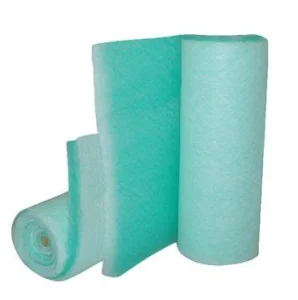
Technical Setup: Washable stainless steel primary mesh pre-filter → G4 fiberglass paint-stop roll → High-loading extruded carbon pellet banks (CTC 80%) with moisture-resistant binding.
Solution B: Paint Spray Booths & Automotive Refinishing
Target Pollutants: Solvent overspray, xylene, toluene, methyl ethyl ketone (MEK).
Technical Setup: Progressive density G2–G4 glass fiber floor filters → Carbon-impregnated pleats → Final V-bank mini-pleat carbon filters engineered for high face velocity.
Solution C: High-Density Transit & Municipal Rail
Target Pollutants: Diesel exhaust fumes, ozone ($O_3$), $NO_x$, road dust.
Technical Setup: Compact honeycomb carbon composite filters with high mechanical vibration resistance and flame-retardant synthetic pre-layers.





Frequently Asked Questions: Technical Engineering & OEM Sourcing
Below are in-depth technical answers curated by Snow Peak senior filtration engineers to solve procurement and design challenges for global B2B buyers:
t_r = Bed Volume (m³) / Airflow Rate (m³/s)
For effective VOC removal, a minimum residence time of 0.1 to 0.5 seconds is required. Snow Peak engineers optimize pleat depth, pleat pitch, and carbon density using computational fluid dynamics (CFD) simulations to maintain optimal residence time while keeping system static pressure drop ($\Delta P$) within the limits of standard HVAC fan curves.