
High-Performance HEPA & VOC Filtration Products
Precision-engineered replacement filter elements and custom industrial filtration modules manufactured to rigorous international standards.




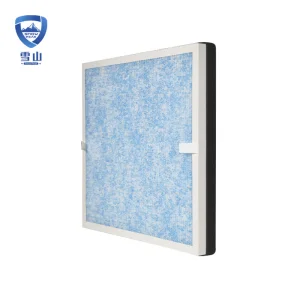


Micro-Glass Fiber Technology in HEPA & ULPA Filtration
Understanding why wet-laid borosilicate glass microfibers remain the undisputed gold standard for ultra-clean commercial and industrial applications.
Micro-Fiber Matrix & Capture Mechanisms
High-efficiency particulate air (HEPA) filters made from glass microfiber paper utilize a randomly oriented matrix of fine glass fibers (diameters ranging from 0.2 to 5.0 micrometers). Unlike simple sieve-like filtration, HEPA fiberglass relies on four primary physical mechanisms to trap airborne contaminants down to sub-micron scales:
- Brownian Diffusion: Controls particles below 0.1 µm. Irregular gas molecular bombardment causes small particles to wander erratically across flow lines, eventually colliding with glass fibers.
- Interception: Dominates for mid-sized particles (0.1 µm to 0.4 µm) that follow the air stream lines but come within one particle radius of a fiber matrix strand.
- Inertial Impaction: Traps heavier particles (> 0.5 µm). Due to mass momentum, these particles cannot navigate the sharp flow turns around glass fibers and impact directly into the fiber wall.
- Electrostatic Enhancement: Proprietary thermal treatments allow specific microfiber blends to retain stable static charges, enhancing initial capture efficiency without structural degradation.
Fiberglass vs. Synthetic (PP/Meltblown)
While synthetic polypropylene (PP) meltblown media is common in budget residential units, micro-glass fiber paper remains superior for industrial, cleanroom, and high-spec OEM equipment for critical structural reasons:
Zero Static Decay: Meltblown synthetic relies heavily on electrostatic charge, which degrades dramatically under high humidity or exposure to organic vapors. Glass fiber filtration is 100% mechanical, offering permanent, non-degrading efficiency throughout its entire service life.
High Temperature & Flame Resistance: Borosilicate glass fiber withstands continuous operating temperatures up to 250°C - 500°C and maintains structural fire retardancy compliant with UL 586 standards.
Global Buyers Sourcing Demands & Requirements
How international procurement managers, cleanroom engineers, and OEM HVAC brands evaluate fiberglass HEPA suppliers.
Low Pressure Drop Optimization
Energy consumption accounts for up to 80% of an industrial air filtration system's total cost of ownership (TCO). Procurement intent has shifted toward mini-pleated fiberglass designs featuring hot-melt separator technology. By maintaining uniform pleat spacing, air velocity across the medium remains even, dropping initial resistance ($\Delta P_0$) by 15% to 25% while conserving fan power in HVAC units.
Compliance & Certification Rigor
Enterprise buyers require total compliance verification under EN 1822:2019, ISO 29463, and ASHRAE 52.2 standards. Leading OEM manufacturers must provide individual factory leak scan certificates using aerosol challenges (DEHS/PAO) to verify that zero bypass exists around the filter frame perimeter, potted edges, or glass fiber media sheet.
Multi-Stage Gas & Odor Adsorption
Commercial air purifiers and industrial exhaust systems increasingly demand composite media solutions. Sourcing teams look for multi-layer combination filters combining high-efficiency fiberglass HEPA paper with activated carbon fabric or cold-catalyst honeycomb layers to eliminate both fine particulates (PM2.5) and gaseous Volatile Organic Compounds (VOCs) within a single structural cassette.
Strategic Sourcing Insight: Modern OEM brands are moving away from single-source component manufacturing toward integrated supply partners capable of offering CAD tooling design, custom continuous polyurethane gasket dispensing, automated pleating, cleanroom assembly, and private-label packaging under one roof.
Shenzhen Snow Peak: Supply Chain Resilience & Smart Manufacturing
Inside our 15+ years national high-tech manufacturing center: How automation, cleanroom standardization, and scale deliver unmatched quality and lead-time stability.
Smart Automated Production Lines
Our Shenzhen manufacturing hub incorporates automated computer-controlled knife and rotary pleating machines. Hot-melt glue bead separators are applied with millimeter precision to eliminate pleat nesting, ensuring uniform airflow velocity and maximum media area utilization. Automated polyurethane robot potting guarantees seamless frame sealing without manual voids.
Cleanroom Workshop Standards (ISO Class 7/8)
Critical industrial HEPA and ULPA filters are assembled inside dedicated ISO Class 8 (100,000-level) and ISO Class 7 cleanrooms. Airborne particle contamination during assembly is strictly controlled, preventing fiber shedding, dust residue, or organic outgassing contamination before product shipping.
Four-Stage Quality Assurance Architecture
Global Industrial & Commercial Application Scenarios
Engineered fiberglass HEPA solutions customized for stringent cleanroom environments, heavy industry, commercial HVAC, and smart home appliances.
Semiconductor & Microelectronics Cleanrooms
Fabrication plants (fabs) require ISO Class 1 to ISO Class 5 air purity. High-temperature, low-outgassing borosilicate glass fiber mini-pleat HEPA/ULPA filters capture 99.999% of airborne particles down to 0.1 µm, safeguarding silicon wafers against airborne chemical contamination and dust defects.
Pharmaceutical & Bio-Containment Labs
In sterile processing and GMP Grade A/B facilities, deep-pleat fiberglass HEPA modules with continuous gel seals or seamless neoprene gaskets prevent microbial bypass. Safe-change Bag-In/Bag-Out (BIBO) housings protect operators during hazardous filter replacement.
Commercial HVAC & Data Centers
Large commercial complexes, hospital ventilation, and cloud data centers utilize MERV 16 to H13 fiberglass v-bank and pocket filters to maintain healthy Indoor Air Quality (IAQ) while keeping cooling coil fan energy resistance minimal.
Industrial Spray Booths & Surface Finishing
Automotive spray booths and furniture coating rooms utilize heat-resistant 600G ceiling filter cotton and progressive-density glass fiber floor paint-stop rolls (G2-G4) to trap overspray paint mist and eliminate surface cratering defects.
Subway & High-Speed Rail Cabin Filtration
Custom vibration-proof aluminum frame fiberglass filters endure rapid ambient pressure shifts and heavy soot dust loading in urban mass transit HVAC systems, extending maintenance intervals by 40%.
OEM Residential Air Purifier Aftermarket
Precision compatible replacement filter cartridges for global brands (Honeywell, Coway, Blueair, Levoit, Germ Guardian). Engineered to match OEM Clean Air Delivery Rates (CADR) and acoustic noise thresholds.
Micro-Glass Fiber vs. Alternative Media Performance
Comparative empirical data showcasing key engineering metrics for critical decision making in air filter specification.
| Filter Media Type | Efficiency Grade | Initial Resistance ($\Delta P_0$) | Dust Holding Capacity | Thermal Limits | Humidity Tolerance | Static Charge Decay Risk |
|---|---|---|---|---|---|---|
| Borosilicate Glass Microfiber | H13 - U15 (EN 1822) | Medium (110 - 220 Pa) | Very High ($> 500 \text{ g/m}^2$) | Up to 250°C - 500°C | 100% RH Resistance | Zero Decay (Mechanical Capture) |
| Meltblown Polypropylene (PP) | E10 - H13 (EN 1822) | Low (70 - 140 Pa) | Moderate ($200 \text{ g/m}^2$) | Max 70°C - 80°C | Degrades at > 80% RH | High Decay (Electret discharge) |
| ePTFE Membrane | H14 - U17 (EN 1822) | Ultra-Low (90 - 160 Pa) | Low (Surface loading) | Up to 150°C - 200°C | Hydrophobic (Excellent) | Zero Decay (Membrane mesh) |
| Composite (Fiberglass + Carbon) | H13 + Gas Phase | Medium-High (140 - 260 Pa) | High Dual-Phase Cap. | Up to 100°C | Good (< 85% RH) | Zero Decay (Mechanical) |
Custom OEM Components & Materials
Explore our expanded catalog of replacement cartridges, specialized ceiling media, and cleanroom maintenance hardware.






Custom OEM / ODM Engineering Workflow
From initial dimensional drawing to mass cleanroom production and global export logistics: how we bring your custom filtration project to market.
Engineering Intake
Share CAD files, target efficiency grades (H13, H14, MERV), pressure drop specs, or original equipment sample units.
Prototyping & Simulation
Our R&D team calculates optimal pleat depth and spacing, produces prototype samples within 3-5 days, and performs bench testing.
Cleanroom Mass Production
Automated pleating, frame potting, continuous gasket dispensing, and 100% DEHS aerosol leak scan testing in ISO Class 8 cleanroom.
Private Label Packaging
Custom retail boxes, barcoding, palletization, export customs clearance, and fast sea/air logistics via Shenzhen ports.
Frequently Asked Questions by OEM & B2B Buyers
Clear, authoritative technical answers addressing common questions regarding HEPA fiberglass manufacturing, testing standards, and customization.
1. Permanent Mechanical Filtration: Glass fiber efficiency is purely mechanical and does not suffer from electrostatic charge decay under ambient humidity or exposure to chemical fumes.
2. Thermal & Fire Resistance: Glass fiber withstands operating temperatures up to 250°C (and special formulations up to 500°C) with UL 586 flame retardancy, whereas synthetic media deforms above 70°C.
3. Rigid Pleat Geometry: Fiberglass paper maintains structural pleat spacing under high airflow turbulence and differential pressure ($\Delta P$), preventing pleat collapse and localized velocity spikes.