
Featured OEM/ODM Intake & Replacement Filter Products
High-precision filtration solutions manufactured under ISO quality standards for global OEM brands, industrial systems, and containment units.




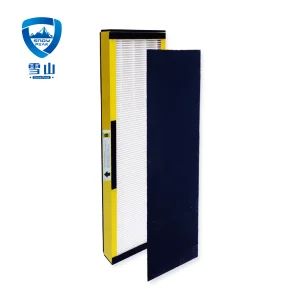



1. Executive Summary & Aerodynamic Fundamentals of HEPA Intake Filtration
In modern industrial manufacturing, power generation, cleanroom operations, and high-performance commercial appliances, the intake stage represents the primary line of defense against atmospheric contaminants. An OEM HEPA Intake Filter (High-Efficiency Particulate Air Intake Filter) is engineered specifically to extract sub-micron airborne particles, chemical aerosols, and bio-contaminants from incoming air streams before they enter critical turbomachinery, internal combustion engines, HVAC handling units, or sensitive indoor environments.
Unlike standard static recirculating filters, intake filters operate under dynamic fluidic pressures, variable face velocities, and fluctuating environmental humidity. Designing and manufacturing an OEM intake filter requires an intricate understanding of aerosol physics and mechanical filtration mechanics. Particles are captured across non-woven glass fiber or synthetic membrane matrices through four primary physical mechanisms:
- Inertial Impaction: Dominant for larger particles ($\ge 1.0\,\mu\text{m}$). As the intake airflow contours around the filter microfibers, heavy particles possess sufficient inertia to deviate from the fluid streamlines and collide directly with the fiber surfaces.
- Direct Interception: Effective for mid-sized dust particles ($0.3\,\mu\text{m} - 1.0\,\mu\text{m}$). Particles following the air streamline come within a distance equal to their radius from a microfiber and become captured.
- Brownian Diffusion: The primary capture mechanism for sub-micron and ultrafine particles ($\le 0.1\,\mu\text{m}$). Random thermal motion (Brownian motion) causes small particles to wander across fluid streamlines, significantly increasing their probability of contacting microfibers.
- Electrostatic Attraction: Enhanced non-woven media utilizes charged electret properties to attract polar and non-polar aerosol particles without imposing an aerodynamic pressure drop penalty.
Key Technical Insight: The efficacy of an OEM HEPA intake filter is evaluated at its Most Penetrating Particle Size (MPPS), typically occurring between $0.12\,\mu\text{m}$ and $0.25\,\mu\text{m}$. True HEPA filters (Grade H13 to H14 according to EN 1822 / ISO 29463) must demonstrate a minimum efficiency of $99.97\%$ to $99.995\%$ at the MPPS under nominal rated intake velocity.
2. Global Industrial & Commercial Landscape of HEPA Intake Filtration
The global demand for high-performance OEM HEPA intake filters is expanding rapidly, driven by stringent clean-air regulations, advancing semiconductor fabrication nodes, expansion of bio-pharmaceutical containment facilities, and increased awareness of indoor air quality (IAQ). Across the global industrial market, intake filtration is categorized into specialized procurement sectors:
Key Market Application Segments
1. Turbomachinery & Power Generation: Heavy-duty gas turbines and industrial compressors require ultra-clean air intake. Dust ingress leads to compressor blade fouling, severe erosion, and cooling hole blockages. Advanced multi-stage intake filter banks utilize hydrophobic HEPA elements to maintain thermal efficiency and extend turbine overhaul intervals.
2. Bio-Pharmaceuticals & Containment (BIBO Systems): High-potency active pharmaceutical ingredient (HPAPI) processing and biosafety level labs (BSL-3/BSL-4) mandate specialized air handling intake and exhaust systems. Bag-In/Bag-Out (BIBO) housings incorporate HEPA filters with PVC containment bags to guarantee zero-exposure filter replacements for maintenance engineers.
3. Microelectronics & SMT Manufacturing: Semiconductor lithography and surface-mount technology (SMT) require continuous positive-pressure air intake filtered to Class 1 (ISO 3) cleanroom specifications to prevent wafer defectivity.
4. Commercial OEM & Household Appliances: Global brands producing residential air purifiers, robotic vacuum cleaners, and building HVAC recovery units require customized mini-pleat HEPA filters. OEMs require exact dimensional tolerances, anti-microbial coatings, and optimized initial pressure drop ($\Delta P$) to match centrifugal fan curves.
| Industry Sector | Intake Filtration Objective | Standard Filter Class | Core Technical Challenges |
|---|---|---|---|
| Gas Turbines | Prevent compressor fouling & corrosion | E10 - H13 (EN 1822) | High face velocity, humidity, salt fog resistance |
| Bio-Pharma (BIBO) | Contain hazardous biologicals & toxins | H13 - H14 (ISO 29463) | Zero-bypass seal, containment changing, DOP leak testing |
| Cleanroom HVAC | Maintain ISO 3 to ISO 8 air purity | H14 - U15 (EN 1822) | Ultra-low pressure drop, uniform air velocity matrix |
| Consumer OEM | PM2.5, VOC & allergen removal | MERV 13 / H13 HEPA | Cost efficiency, acoustic damping, custom form factors |
3. China OEM Manufacturing Efficiency & Supply Chain Ecosystem
As international enterprise buyers seek optimal total cost of ownership (TCO) alongside rigorous technical compliance, China's advanced filtration manufacturing ecosystem offers unparalleled strategic advantages. Modern Chinese OEM/ODM filter factories have transformed from simple assembly lines into fully integrated engineering hubs featuring automated pleating, robotic polyurethane gasketing, laser-based scan testing, and proprietary media formulation.
Core Ecosystem Strengths
- Upstream Material Integration: Chinese factories maintain direct vertical integration with premier meltblown nonwoven, ePTFE membrane, and activated carbon manufacturers. This ensures rapid material customization (e.g., laminating wire mesh for structural rigidity or compounding antibacterial agents directly into synthetic fibers).
- Automated High-Precision Pleating: State-of-the-art thermo-sol hot-melt separation pleating lines allow precise control over pleat height, pitch density, and spacing uniformity. This minimizes dead zones in the intake surface area, optimizing dust holding capacity (DHC).
- 100% Individual Factory Leak Testing: Tier-1 OEM suppliers utilize automated TSI 8130/8130A automated filter testers and Topas scan test systems. Each HEPA filter undergoes aerosol photometer leakage verification (DOP/PAO testing) prior to packaging.
- Unrivaled Prototyping Speed: From initial CAD/STEP engineering files to physical functional samples, Chinese OEM partners can deliver customized intake filter prototypes within 5 to 7 working days.
Procurement Strategic Value: Leveraging China's OEM intake filter production allows global brands to reduce tooling expenditures by up to 60% while maintaining absolute compliance with US (ASHRAE/AHAM) and European (CE/EN) market standards.
4. Localized Industrial & Commercial Application Scenarios
Engineering an intake filter requires tailoring structural and media parameters to specific operating environments. Below are five real-world deployment scenarios illustrating specialized OEM engineering solutions:
Scenario A: Industrial Spray Booth Intakes
Environment: Automotive body painting and precision coating lines.
Requirement: Uniform ceiling air intake free of dust particles down to $5\,\mu\text{m}$, combined with paint mist retention.
OEM Solution: Progressive-density 600G synthetic ceiling filter cotton laminated with protective scrims, ensuring turbulence-free laminar airflow across spray chambers.
Scenario B: Nuclear & Bio-Safety Exhaust/Intake
Environment: Hazardous particle isolation facilities.
Requirement: Contained filter changeout without exposing maintenance personnel to toxic or viral aerosols.
OEM Solution: Heavy-duty PVC Bag-In/Bag-Out (BIBO) containment bags equipped with glove ports, security O-rings, and heavy-gauge elastic cords.
Scenario C: High-End Consumer Air Purifiers
Environment: Residential living areas, offices, and healthcare suites.
Requirement: Dual PM2.5 particulate filtration and gaseous VOC/odor removal in a single compact cartridge.
OEM Solution: Mini-pleated True H13 HEPA laminated with honeycomb activated carbon, fitted with injection-molded or elastic EVA gaskets to eliminate air bypass.
Scenario D: Heavy Dust Commercial Vacuums
Environment: Construction cleanup and industrial floor sweeping.
Requirement: Cylindrical intake filters capable of withstanding mechanical vibration and reverse pulse cleaning.
OEM Solution: Spunbond polyester/HEPA composite round cartridges with expanded metal inner mesh supports and washable membrane coatings.
5. Global Enterprise Procurement Framework & Technical Metrics
When sourcing OEM HEPA intake filters, enterprise procurement teams must evaluate manufacturers beyond unit price alone. Engineering managers and global procurement directors should utilize the following quantitative evaluation matrix during vendor qualification:
| Technical Parameter | Testing Protocol / Standard | Target Specification Benchmark | Procurement Selection Significance |
|---|---|---|---|
| Initial Resistance ($\Delta P$) | EN 1822-4 / ASHRAE 52.2 | $\le 180\text{ Pa}$ at rated intake velocity | Directly governs fan motor power consumption & energy costs |
| Fractional Efficiency | TSI 8130 / EN 1822 MPPS | $\ge 99.97\%$ @ $0.3\,\mu\text{m}$ (H13) | Determines protection level for downstream equipment or indoor air |
| Dust Holding Capacity (DHC) | ISO 16890 / ASHRAE 52.2 dust loading | Maximized loading in grams ($g/m^2$) | Dictates operational lifespan and filter replacement frequency |
| Burst Strength & Frame Rigidity | ISO 29463 structural stress test | $\ge 1500\text{ Pa}$ differential collapse pressure | Prevents filter blow-out during high pressure surges or wet weather |
| Gasket Seal Integrity | ISO 14644-3 seal leak test | Zero leak paths under compression | Prevents bypass of unfiltered ambient air around filter frame |
6. Future Technological Trends in Air Intake Filtration
The air intake filtration industry is undergoing rapid innovation driven by smart building automation, energy conservation goals, and new polymer materials science:
- ePTFE Membrane Transition: Traditional micro-glass fiber media is increasingly being replaced by expanded Polytetrafluoroethylene (ePTFE) membranes. ePTFE offers extremely low initial pressure drop (up to 40% lower than glass fiber), superior chemical durability, and zero fiber-shedding risks.
- Smart Differential Pressure Sensors & IoT Integration: Modern industrial intake filter banks are adopting embedded RFID chips and differential pressure ($\Delta P$) sensors that transmit real-time dust loading data to building management systems (BMS) for predictive maintenance.
- Sustainable & Recyclable Bio-based Frames: To meet strict ESG (Environmental, Social, and Governance) requirements, leading OEM manufacturers are introducing fully recyclable ABS, polypropylene, or biodegradable sugarcane-derived PLA filter frames.
7. Enterprise Procurement & Technical FAQ
Frequently asked technical and commercial questions regarding OEM HEPA intake filter manufacturing, custom sizing, quality assurance, and international logistics.
Complete OEM Replacement & Industrial Product Series
Explore our full catalog of aftermarket replacement filter assemblies, vacuum cartridges, and specialized air purification materials.





