Featured OEM & Wholesale Air Filtration Products
Direct factory supply of high-efficiency HEPA, activated carbon, and specialized HVAC combination filters for global enterprise distributors and system integrators.


1. Executive Industry Whitepaper: The Evolution of Carbon Air Filtration
As global environmental standards tighten and indoor air quality (IAQ) governance transitions toward holistic molecular purification, enterprise buyers require more than simple particulate filtration. Modern commercial HVAC systems, semiconductor manufacturing cleanrooms, and municipal air handling infrastructures demand chemical adsorption platforms capable of eliminating Volatile Organic Compounds (VOCs), corrosive airborne molecular contaminants (AMCs), and hazardous trace gases under dynamic thermodynamic conditions.
Activated carbon air filtration has evolved from raw, unimpregnated virgin carbon beds to highly engineered, chemically functionalized catalytic matrix structures. Today's commercial procurement strategy emphasizes low differential pressure drop, optimized Residence Time, elevated Carbon Tetrachloride (CTC) adsorption capacity values, and zero secondary desorptive emissions under elevated temperature or humidity stress.
ESG & Decarbonization Mandates
Global net-zero policies necessitate HVAC air filters that balance high chemical holding capacity with reduced fan energy draw. Modern carbon-pleated media reduces static pressure resistance by up to 40% compared to traditional loose-fill pellet trays, significantly cutting commercial kWh consumption.
Advanced AMC Contaminant Control
Micro-electronics fabs and lithography cleanrooms require sub-PPBb level capture of siloxanes, organophosphates, and acid gases. Chemical impregnation (KOH, KI, H3PO4) on activated carbon substrates ensures irreversible chemisorption for specific targeted gas species.
Hybrid Particulate-Gas Matrices
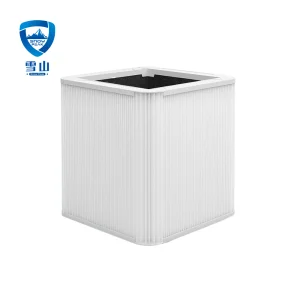
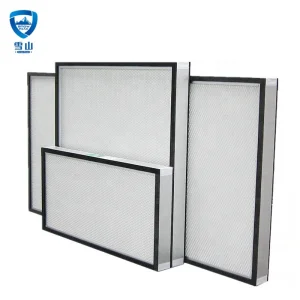
Combining True H13 HEPA meltblown glass-fiber or synthetic layers with a mini-pleated activated carbon substrate solves structural envelope limitations, providing dual-stage particulate and gas-phase capture in a single compact frame filter.
2. Chemical Engineering: Adsorption Physics & Media Substrates
The efficiency of a wholesale carbon filter depends heavily on its internal pore architecture, precursor selection, and activation method. Activated carbon functions through two primary mechanisms: Physical Adsorption (Physisorption) via van der Waals forces across a high specific surface area, and Chemical Adsorption (Chemisorption) via impregnated surface reagents that chemically react with target gases.
Precursor Matrix & Micro-Pore Distribution
Different raw precursors yield vastly different pore diameter distributions. Selecting the correct precursor is critical for targeting specific molecular weights and kinetic diameters:
| Precursor Material | Pore Distribution Focus | Specific Surface Area (m²/g) | Target Gas Speciation | Primary Industrial Use |
|---|---|---|---|---|
| Coconut Shell | Microporous (< 2 nm) | 1,100 – 1,400 | Low MW VOCs, Benzene, Formaldehyde, Odors | Air Purifiers, HVAC, Cleanroom AMCs |
| Bituminous Coal | Meso / Macroporous (2 - 50 nm) | 800 – 1,050 | Higher MW Hydrocarbons, Complex VOC Blends | Industrial Exhaust, Municipal Odor Control |
| Synthetic Resin / Polymer | Monodisperse Ultramicroporous | 1,200 – 1,600 | Ultra-trace Semiconductor AMCs, Siloxanes | Photolithography Scanner Air Filtration |
| Wood / Lignite | Macroporous (> 50 nm) | 600 – 900 | Large Organic Molecules, Color & Heavy Vapors | Coarse Industrial Pre-treatment Filters |
Chemical Impregnation for Targeted Chemisorption
Virgin activated carbon exhibits minimal affinity for small, highly polar, or inorganic gas molecules like Hydrogen Sulfide ($H_2S$), Ammonia ($NH_3$), or Sulfur Dioxide ($SO_2$). To capture these species, wholesale carbon filter media is infused with targeted chemical impregnants:
Alkaline Impregnation (KOH / KI)
Neutralizes acidic gases ($H_2S$, $SO_2$, $HCl$, $HF$) via chemical conversion into solid inorganic salts within the carbon pores. Essential for wastewater treatment IAQ and paper mill control rooms.
Acidic Impregnation ($H_3PO_4$ / $H_2SO_4$)
Protonates basic compounds, specifically Ammonia ($NH_3$) and Amines, converting volatile nitrogenous bases into non-volatile ammonium salts. Widely specified in animal research and chemical labs.
Oxidizing Impregnation ($KMnO_4$)
Promotes catalytic oxidation of low molecular weight aldehydes, particularly Formaldehyde ($CH_2O$) and Ethylene, transforming pollutants into harmless $CO_2$ and water vapor.
3. Global Enterprise Procurement & Total Cost of Ownership (TCO)
When sourcing wholesale carbon filters for large-scale enterprise deployments, direct unit price represents less than 30% of the lifetime operation cost. Strategic buyers evaluate air filtration assets through a rigorous Total Cost of Ownership framework considering fan energy consumption, initial vs final differential pressure, continuous gas breakthrough curves, and filter replacement cycles.
The Energy Drop Equation
Static resistance across an air filter directly dictates fan electrical power consumption. The annual fan energy cost ($E_c$) can be calculated using the formula:
E_c = (Q × ΔP × t) / (1000 × η) × C_kWh
Where Q is airflow volume ($m^3/s$), ΔP is average pressure drop ($Pa$), t is operational hours, η is fan efficiency (0.6 - 0.8), and C_kWh is the electricity tariff. Mini-pleat continuous carbon media significantly reduces average ΔP, generating substantial annual electricity savings across commercial buildings.
Evaluating Mass Efficiency & Breakthrough Curves
A wholesale carbon filter should be rated using standard challenge gas conditions (e.g., ISO 10121 or ASHRAE 145.2 standards). Buyers must examine two crucial performance curves:
- Initial Removal Efficiency (IRE): The percentage of gas captured on the first air pass at rated face velocity.
- Breakthrough Time ($t_b$): The operational duration until downstream gas concentration exceeds acceptable environmental exposure thresholds (e.g., 5% or 10% penetration).
4. Macro Industry Solutions & System Integration
Tailored air purification engineered to meet strict technical specifications across specialized vertical markets.
Semiconductor Cleanrooms
Contaminant Target: AMCs, Siloxanes, Acids, Bases.
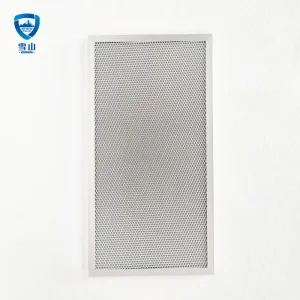
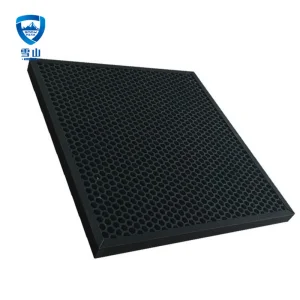
Solution: Aluminum-framed continuous honeycomb activated carbon trays with chemical-grade synthetic media delivering sub-PPBb gas control with zero dust shedding.
Commercial HVAC & Smart Towers
Contaminant Target: Outdoor $NO_2$, $SO_2$, Ozone, Traffic Exhaust, VOCs.
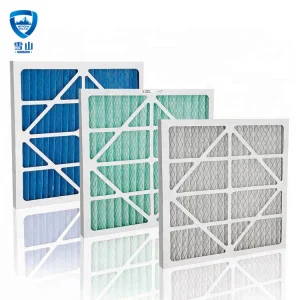
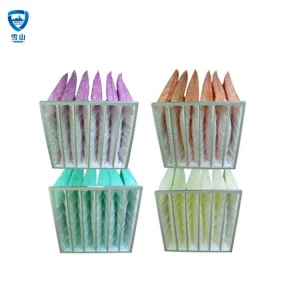
Solution: MERV 13 to MERV 16 pleated dynamic carbon-impregnated filters replacing standard pre-filters for seamless retrofit without fan modifications.
Hospitals & Laboratories
Contaminant Target: Anesthetic Gases, Formalin, Xylene, Bio-odors.
Solution: Deep-bed refillable carbon cannisters and HEPA-carbon multi-stage containment housings with gas-tight gaskets and BIBO changeout support.
Automotive Paint Booths
Contaminant Target: Solvent Vapors, BTEX (Benzene, Toluene, Ethylbenzene, Xylene).
Solution: High-capacity extruded carbon panel cells designed for elevated face velocities ($2.5 m/s$) and high humidity resistance.
5. Quality Assurance, Compliance, and Localized Support
Extensive international testing certifications ensure seamless regulatory compliance across global jurisdictions, reducing risk for wholesale importers and OEM brand owners.
International Testing Standards
Our carbon filter series are rigorously batch-tested under international standard protocols:
- ISO 10121-1/-2: Test methods for assessing the performance of gas-phase air cleaning media and devices.
- ASHRAE 145.1 / 145.2: Laboratory testing of gas-phase air-cleaning systems.
- ISO 16890 / EN 779: Particulate filtration efficiency grading ($ePM_1, ePM_{2.5}, ePM_{10}$).
- UL 900: Standard for Air Filter Units fire performance compliance.
Chemical & Material Safety
Environmental and chemical safety verification guarantees zero hazardous off-gassing from adhesives, frames, or activated carbon impregnants during continuous operation:
- REACH & RoHS Compliant: Free of heavy metals, polybrominated biphenyls, and SVHCs.
- Low Outgassing Adhesives: Hot-melt polyurethane and EVA glues tested for ultra-low organic off-gassing in cleanrooms.
Localized Supply Chain Support
Providing global partners with end-to-end logistics assistance, private labeling, custom structural engineering, and responsive support:
- Custom framing: Galvanized steel, extruded aluminum, stainless steel, plastic ABS, or beverage board.
- Flexible MOQs for initial market verification trials.
- Direct export packaging, barcode compliance, and OEM private label drop-shipping support.
6. Technical Roadmap & Future Outlook (2025–2030)
As air purification advances, next-generation wholesale carbon filter designs incorporate nanostructured materials, smart differential sensors, and sustainable bio-based carbon matrices.
Metal-Organic Frameworks (MOFs)
Integration of synthetic MOFs with activated carbon substrates, increasing theoretical surface areas up to 3,000+ m²/g. This technology delivers unprecedented adsorption capacity for targeted polar gases like $NH_3$ and $NO_x$ with reduced media weight.
IoT & Gas Saturation Sensing
Embedding printable wireless gas sensors and differential pressure monitoring directly into the carbon filter frame, allowing building management systems (BMS) to receive real-time alerts when chemical saturation reaches replacement thresholds.
Circular Bio-Carbon Precursors
Transitioning precursor sourcing toward sustainably harvested agricultural waste streams engineered via green steam activation, achieving carbon-neutral production certified under global environmental footprints.
7. Enterprise Buyer FAQ (Frequently Asked Questions)
Common technical and commercial questions answered by our engineering and wholesale procurement specialists.
Complete Wholesale Product Catalog Portfolio
Explore our complete manufacturing lineup of high-performance replacement filters, specialized honeycomb media, and industrial HVAC air filtration products.