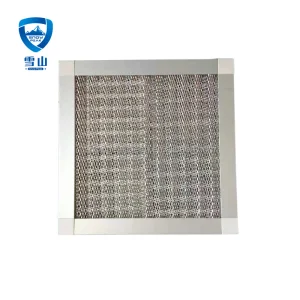
High-Efficiency Filter Assemblies & OEM Replacements
Explore our top-tier engineered air filter products manufactured under ISO 9001 and ISO 16890 standards for global exporters, HVAC contractors, and distributors.







Executive Summary & Technical Fundamentals of F7 Filter Material
In modern industrial and commercial ventilation, F7 efficiency grade filter material acts as the indispensable workhorse for fine dust retention, airborne contaminant containment, and pre-HEPA protection.
EN 779:2012 to ISO 16890 Technical Paradigm Shift
Historically classified under EN 779:2012 as F7 grade (demonstrating an average efficiency between 80% and 90% for 0.4 µm synthetic particles), modern filtration engineering evaluates this material under the global ISO 16890 standard. Under ISO 16890, F7 filter media corresponds directly to the ISO ePM1 50%–65% and ISO ePM2.5 65%–80% categories. This standard measures true fractional efficiency across particle size spectrums from 0.3 µm to 10 µm, ensuring real-world performance validation against urban smog, combustion particulate, bacterial carriers, and fine industrial dusts.
Meltblown Synthetic Multi-Layer Architecture
Premium F7 filter material produced by top-tier exporters utilizes a progressive density multi-layer matrix. Typically comprised of a spunbond protective layer, a electrostatically charged meltblown microfiber core (fiber diameter between 1.0 to 3.0 µm), and a high-tensile backing nonwoven, this material achieves optimal depth filtration. Unlike traditional glass fiber media which is prone to fiber shedding and brittle fracture during pleating, synthetic F7 composite media offers total shedding resistance, superior mechanical flexibility, and excellent resistance to moisture-induced degradation.
Material Science: Synthetic Composite Fiber vs. Micro-Glass Media
A detailed comparative analysis of structural integrity, pressure drop trajectory, electrostatic discharge behavior, and operating economics.
| Performance Parameter | Advanced F7 Synthetic Composite Media | Traditional Micro-Glass Fiber Media | Engineering Impact & B2B Advantage |
|---|---|---|---|
| Fiber Shedding & Safety | Zero Shedding (Polypropylene/PET continuous filaments) | Risk of micro-glass fiber breakage & shedding | Crucial for food processing, cleanrooms, and IAQ safety standards. |
| Mechanical Pleatability | High burst strength, high flexibility, ultra-durable seam ultrasonic welding | Brittle, sensitive to scoring depth, easily damaged in high air velocity | Reduces factory scrap rate during pocket welding or pleating by over 14%. |
| Initial Pressure Drop (at 0.2m/s) | 35 Pa - 48 Pa (Optimized charge & gradient fiber density) | 50 Pa - 65 Pa | Lowers HVAC fan energy consumption by up to 22% over product lifecycle. |
| ISO 16890 Isopropanol (IPA) Discharge | Maintains mechanical ePM1 50%+ efficiency post-discharge | Purely mechanical (unaffected by IPA) | Snow Peak's dual-charge technology ensures compliance after static decay. |
| Moisture & Chemical Resistance | Hydrophobic, mold resistant (100% RH resistant), chemical inertness | Susceptible to moisture binder breakdown over extended humidity exposure | Guarantees structural stability in marine and high-humidity HVAC environments. |
Corona Hydro-Charging Technology
Our F7 meltblown media utilizes advanced hydro-charging electret technology. By embedding permanent dipoles deep within the polypropylene polymer matrix during high-pressure water-jet electrification, the media retains high electrostatic attraction for sub-micron particulate without suffering rapid decay in real-world atmospheric conditions.
Progressive Density Layering
Rather than relying on a uniform density profile, our wholesale F7 media rolls feature a coarse upstream particle catcher, a medium-density transition core, and an ultra-fine downstream retention layer. This gradient structure prevents premature surface loading, boosting Dust Holding Capacity (DHC) beyond 450 g/m².
Thermal Point Bonding Strength
Utilizing thermal point calendar bonding on the PET support grid guarantees exceptional tensile strength (MD > 300 N/5cm, TD > 220 N/5cm). This prevents pocket ballooning, deformation, or air bypass under turbulent air velocities up to 3.2 m/s within Air Handling Units (AHUs).
China Factory 4.0: Supply Chain Resilience & Manufacturing Excellence
Leveraging state-of-the-art nonwoven extrusion lines, automated inline laser scanning, and strategic Shenzhen port logistics for unmatched export efficiency.
Inline Laser Thickness & Resistance Measurement
Continuous real-time monitoring across 2.4-meter wide media rolls guarantees grammage uniformity within ±2.5% tolerance across every square meter exported.
Scalable Monthly Capacity (500+ Metric Tons)
High-speed dual-beam meltblown extrusion lines provide high production throughput, ensuring container-load lead times under 10 business days.
TSI 8130 Automated Quality Testing
Every batch undergoes rigorous particle penetration and pressure differential testing using TSI 8130 Automated Filter Testers prior to roll slitting and packaging.
Optimized Export Roll Packaging
Heavy-duty poly-wrapped, vacuum-compressed roll packaging reduces freight volume by up to 35%, maximizing 40ft HQ container loading efficiency.
Macro-Industry Solutions & Air Handling Integration
Tailored F7 filter media deployment across critical commercial, industrial, and high-tech operational environments.
Commercial HVAC & Building Ventilation
Commercial real estate, shopping complexes, and hospital ventilation systems rely on F7 media to maintain strict Indoor Air Quality (IAQ) compliance. Installed as secondary pocket filters or pleated V-bank assemblies, F7 media traps pollen, spores, mold, and atmospheric smog, safeguarding occupant health while protecting heating and cooling coils from fouling.
Semiconductor & Pharmaceutical Pre-Filtration
In ISO Class 5-8 cleanrooms, protecting expensive terminal H13/H14 HEPA and U15 ULPA filters is paramount for operating cost control. F7 filter media serves as an effective intermediate stage, removing 80-90% of sub-micron particulate burdens and extending the operational service life of final HEPA filters by up to 250%.
Gas Turbine & Heavy Industrial Air Intakes
Gas power plants and offshore machinery demand robust, moisture-resistant filtration under high air velocities. Hydrophobic synthetic F7 media resists salt spray, ambient fog, and heavy dust loading, preventing turbine blade erosion and maintaining power output efficiency.
Global Enterprise Procurement & Total Cost of Ownership (TCO)
How optimizing media selection reduces lifecycle operational costs, fan energy penalties, and maintenance frequency for filter manufacturers.
Energy Efficiency & Fan Power Reduction
Over 70% of an HVAC system's total operating cost is directly attributable to fan electrical energy. By engineering wholesale F7 filter media with an initial pressure drop up to 15 Pa lower than industry averages, building operators realize significant, measurable reductions in annual kilowatt-hour (kWh) consumption without sacrificing particulate removal efficiency.
OEM Roll Customization & Waste Reduction
We provide custom roll widths (from 100mm to 2400mm), pre-slit edges, variable roll lengths (up to 500 meters), and pocket sewing lines. This eliminates trim waste on automated pocket-making or pleating equipment, directly increasing factory yield margins for global filter converters.
Technological Roadmap & Future Innovation Outlook
Next-generation advancements shaping the future of industrial meltblown composites and smart air filtration media.
1. Electrospun Nanofiber Lamination
Integrating ultrathin electrospun PA66 or PVDF nanofiber layers (fiber diameter 50-100 nm) onto the F7 synthetic substrate. This achieves pure mechanical retention of sub-micron particles with negligible initial pressure drop increase, completely eliminating reliance on electrostatic charge retention.
2. Bio-Based Bio-Polymer Fibers
In response to global ESG mandates and circular economy initiatives, R&D is accelerating the deployment of polylactic acid (PLA) and recycled rPET meltblown media. These eco-friendly F7 materials match traditional synthetic performance while lowering carbon footprint metrics by up to 40%.
3. Antimicrobial & VOC Functionalization
Functionalizing F7 nonwoven matrices with nano-silver zinc complexes or cold catalyst coatings enables simultaneous capture of airborne particulate, destruction of viable microbes/bacteria, and decomposition of gaseous formaldehyde and VOCs in a single composite pass.
International Compliance, Regulatory & Localized Support
Rigorous quality assurance, certified international testing, and end-to-end export documentation support for seamless global logistics.
ISO 16890 & EN 779 Lab Testing
Full third-party test reports (SGS / FIATEC) documenting fractional efficiency curves, initial resistance, and IPA discharge compliance.
REACH & RoHS Chemical Safety
100% free of SVHC substances, heavy metals, halogenated flame retardants, or harmful chemical binders, ensuring compliant European import.
Localized Technical Consulting
Direct engineering support for filter frame fitting, ultrasonic pocket welding parameter alignment, and pleating machine tension settings.
Flexible Freight Terms (FOB/CIF/DDP)
Exporting directly through Shenzhen, Guangzhou, or Hong Kong ports with complete customs clearing documentation and multi-currency billing.
Executive Technical Q&A: F7 Filter Media Sourcing
Answers to critical technical, quality control, and procurement questions asked by international filter manufacturers.
Explore Additional OEM Air Filters & Media Series
From specialty carbon-sandwiched fabrics to HEPA replacement cartridges and roll media for industrial ventilation.