
Premium Compatible Replacement Filters for Brazil
Engineered for exact mechanical fit, superior CADR ratings, and tropical climate durability across Brazilian residential and commercial HVAC markets.



Brazil Air Purification Market Landscape: Demand, Challenges & Opportunities
An in-depth analysis of airborne particulate burdens, tropical micro-climates, and rising consumer reliance on premium brand replacement filters like Blueair across Latin America's largest economy.
Brazil represents one of the fastest-growing markets for residential, commercial, and industrial air purification in South America. As urbanization accelerates across major metropolitan corridors—including Metropolitan São Paulo, Rio de Janeiro, Belo Horizonte, and the industrial hub of Caxias do Sul—indoor air quality (IAQ) has surged to the forefront of environmental health policy and corporate wellness initiatives. Commercial property managers, hospital administrators, and retail importers are actively seeking robust, high-performance OEM and ODM supply partners who understand the distinct environmental and regulatory nuances of Brazil.
Key Market Driver: The Brazilian air filter replacement market is expanding at an estimated CAGR of 8.4%. High demand for compatible replacement units for premium Swedish brands such as Blueair (including Blue Pure 211+, 411, Classic 200/400/600 series, and HealthProtect™ series) is fueled by growing e-commerce retail networks and strict ANVISA workplace air quality mandates.
1. Macro-Environmental Factors Impacting Brazilian Indoor Air Quality
Understanding the Brazilian operational environment requires examining three distinct atmospheric phenomena:
- Agricultural Burnings (Queimadas) and Seasonal Wildfires: During the dry season (typically May through October), severe agricultural burning across the Central-West and Amazonian border states releases vast plumes of fine particulate matter (PM2.5 and PM10), black carbon, and volatile organic compounds (VOCs). Wind currents carry these pollutants thousands of kilometers south into densely populated cities like São Paulo and Campinas, causing severe atmospheric haze and skyrocketing indoor particulate counts.
- Tropical High Humidity and Bio-Aerosols: Brazil’s predominantly tropical and sub-tropical climate sustains elevated relative humidity levels (often exceeding 75-80%). High ambient humidity creates an ideal breeding ground for mold spores, fungal colonies, dust mites, and bio-allergens inside HVAC ductwork and residential spaces. Standard paper-based filter media rapidly degrade, buckle, or succumb to bacterial growth under these humid conditions.
- Urban Vehicle Density & Industrial Emissions: Heavy traffic congestion in metropolitan centers generates high concentrations of diesel particulate matter, nitrogen oxides (NOx), and ground-level ozone. Industrial zones such as the Free Trade Zone of Manaus (Zona Franca de Manaus) and the ABC region of São Paulo require multi-stage air filtration to safeguard sensitive electronics manufacturing, pharmaceutical assembly, and food processing lines.
2. Regulatory Frameworks: ANVISA RE 09/2003 & ABNT Standards
Procurement professionals importing air filters into Brazil must align with stringent national regulatory standards. The National Health Surveillance Agency (ANVISA) enforces Resolution RE No. 09/2003, which establishes reference standards for indoor air quality in public and collective air-conditioned environments. ANVISA specifies maximum allowable limits for airborne fungi, total dust, chemical contaminants, and carbon dioxide.
Furthermore, the Brazilian Association of Technical Standards (ABNT) publishes ABNT NBR 16401, governing building central air conditioning systems. Compliance with these standards demands air filter replacements that maintain strict MERV ratings (MERV 8 through MERV 16) and EN1822 certified HEPA efficiency (H13 to H14), while offering low initial resistance to prevent excessive power consumption on commercial HVAC chillers and air handling units (AHUs).
Engineered Blueair Compatible Filtration Technology
How Snow Peak’s advanced manufacturing process delivers equal or superior performance compared to original equipment manufacturer (OEM) specifications.
HEPASilent™ Compatible Media
Combines high-density meltblown polypropylene fibers with electrostatic charging. Achieves 99.97% removal efficiency down to 0.1 microns while delivering up to 30% lower static pressure than dense traditional mechanical HEPA media.
Tropical Moisture Barrier
Specifically treated hydrophobic non-woven backing prevents mold growth, pleat collapse, and bacterial breeding under high Brazilian humidity (75-95% RH), extending operational filter lifespan by up to 40%.
High-CTC Coconut Carbon
Impregnated with virgin coconut-shell activated carbon exhibiting a high Carbon Tetrachloride (CTC) adsorption value (60-80%). Formulated to effectively eliminate formaldehyde, bio-burn smoke, and urban VOC odors.
Technical Specification & Performance Comparison Matrix
Quantitative parameters comparing Snow Peak compatible filters against OEM standard thresholds tested under tropical operating conditions.
| Filtration Parameter | OEM Standard Baseline | Snow Peak Brazil-Spec Compatible | Operational Benefit for Brazilian Importers |
|---|---|---|---|
| Particulate Efficiency (0.1 - 0.3 µm) | ≥ 99.97% (H13 Grade) | ≥ 99.99% (Electrostatically Enhanced) | Superior capture of ultra-fine smoke particles during dry season burnings. |
| Initial Pressure Drop @ 0.5 m/s | 32 Pa - 38 Pa | 26 Pa - 30 Pa | Lower fan resistance, reducing unit energy draw and motor heat build-up. |
| Humid Environment Resistance | Standard Cellulose Blend | 100% Synthetic Hydrophobic Polypropylene | Eliminates structural distortion and bacterial fouling under 90%+ RH. |
| Active Carbon CTC Adsorption | 50% CTC Rating | 65% - 80% CTC Virgin Coconut Shell Carbon | Enhanced gas-phase filtration of urban smog and industrial sulfur compounds. |
| Frame Structural Integrity | Standard Cardboard / Flexible Foam | Foldable High-Density Polypropylene / EVA Gasket | Air-tight edge seal preventing bypass; resilient against international shipping damage. |
The China Manufacturing Edge: Why Brazilian Importers Partner with Snow Peak
Leveraging Shenzhen’s high-tech manufacturing ecosystem to deliver cost optimization, supply continuity, and bespoke OEM packaging to the Latin American market.
Navigating the complex international trade bridge between China and Brazil requires more than just manufacturing capacity; it demands deep expertise in international customs compliance, quality management systems, and specialized export packaging. As a national high-tech enterprise headquartered in Shenzhen, Shenzhen Snow Peak Clean Technology Co., Ltd. stands as a premier direct factory manufacturer for global buyers.
1. Direct Factory Cost Optimization & Duty Tariff Alignment
Importing into Brazil involves navigating Mercosul Common External Tariffs (TEC) and domestic tax structures including IPI, PIS, COFINS, and ICMS. By purchasing direct from Snow Peak’s automated manufacturing lines, Brazilian importers bypass intermediary markups, securing factory-gate pricing that absorbs local import duties while preserving healthy retail and wholesale profit margins.
2. 4-Stage Strict Quality Control (IQC to OQC)
Every lot of Blueair-compatible filters produced for Brazil undergoes a four-tier inspection regime: Incoming Quality Control (IQC) on raw meltblown media; In-Process Quality Control (IPQC) during automated pleating and hot-melt gluing; Finished Quality Control (FQC) for CADR and pressure drop verification; and Outgoing Quality Control (OQC) for transit packaging resilience.
3. Specialized Maritime Logistics: Shenzhen to Santos & Paranaguá
Snow Peak operates in close proximity to major deep-water shipping hubs including Shenzhen (Yantian/Shekou) and Guangzhou (Nansha). We offer streamlined container loading (FCL/LCL), optimized export documentation (Bill of Lading, Commercial Invoice, Packing List, Certificate of Origin), and moisture-sealed sea freight packaging to prevent salt spray and moisture ingress during the 30-to-40-day transit across the Atlantic Ocean to the Port of Santos or Paranaguá.
Target Deployment Sectors Across Brazil
Tailored filtration engineering for residential comfort, critical healthcare, commercial office towers, and heavy industrial facilities.
High-Density Luxury Residential Real Estate
In luxury high-rise apartments across Jardins and Itaim Bibi in São Paulo, or Barra da Tijuca in Rio de Janeiro, homeowners rely heavily on Blueair Blue Pure 211+, 411, and Classic units. Snow Peak’s direct replacement filter kits feature private-label customized retail packaging, barcode integration, and eco-friendly cardboard framing suitable for premium retail stores and Brazilian e-commerce platforms (Mercado Livre, Amazon Brasil, and Magazine Luiza).
Private Hospitals, Clinics & Cleanrooms
Healthcare institutions in Brasília and Porto Alegre mandate stringent airborne pathogen control. Our H13 and H14 cleanroom-grade HEPA filters and compatible Blueair replacement elements capture viruses, bacteria, and fungal spores with 99.97%+ efficiency, maintaining ANVISA compliance in intensive care units (ICUs), surgical suites, and pharmaceutical laboratories.
Corporate Office Complexes & Hospitality
Five-star hotels and multinational corporate headquarters along Avenida Paulista utilize centralized HVAC systems equipped with V-Bank, pocket, and mini-pleat HEPA filters. Snow Peak supplies robust HVAC primary and secondary replacement filters designed to reduce HVAC blower pressure drop, trimming energy overhead while protecting indoor occupants from urban traffic smog.
Industrial Manufacturing & Agribusiness Facilities
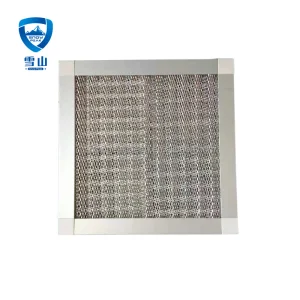
Agribusiness processing centers in Mato Grosso and industrial automotive plants in Paraná demand heavy-duty particulate filtration. Our washable stainless steel mesh primary filters and high-capacity pocket bag filters handle heavy grain dust, metal shavings, and aggressive ambient particulates, extending the operational life of downstream cleanroom HEPA filters.
Step-by-Step Import & Customs Clearance Guide for Brazil
Practical steps for Brazilian B2B procurement managers to streamline customs duty processing, NCM classification, and product packaging.
1. NCM Code Classification
Air filters are typically classified under NCM Code 8421.39.20 (Industrial/Household Air Filtering Equipment & Elements). Correct NCM classification ensures smooth Siscomex registration and accurate calculation of Import Duty (II) and IPI taxes.
2. RADAR License Verification
Importers in Brazil must possess an active RADAR license (Ambiente de Registro e Rastreamento dos Atuantes nos Recintos Alfandegários) issued by the Receita Federal to execute customs clearance for full container loads (FCL) or groupage (LCL).
3. Private Label & Packaging
Snow Peak offers complete OEM private labeling. We customize inner retail boxes, master cartons, EAN-13 barcodes, and Portuguese instruction manuals tailored specifically for the Brazilian retail market requirements.
Frequently Asked Questions for Brazilian Buyers & Importers
Expert answers addressing compatibility, tropical durability, regulatory compliance, and container shipping options.
Full Industrial & Air Purifier Filter Lineup for Brazil
Explore our complete OEM replacement collection, HVAC ventilation filters, and raw roll media manufactured for Latin American commercial buyers.





Partner with China’s Leading Air Filter Manufacturer for Brazil
Looking for reliable, cost-effective OEM/ODM Blueair compatible replacement filters or industrial HVAC media tailored for the Brazilian market? Contact our international engineering sales team today for free samples, technical specifications, and factory wholesale quotations.
Send Inquiry Now